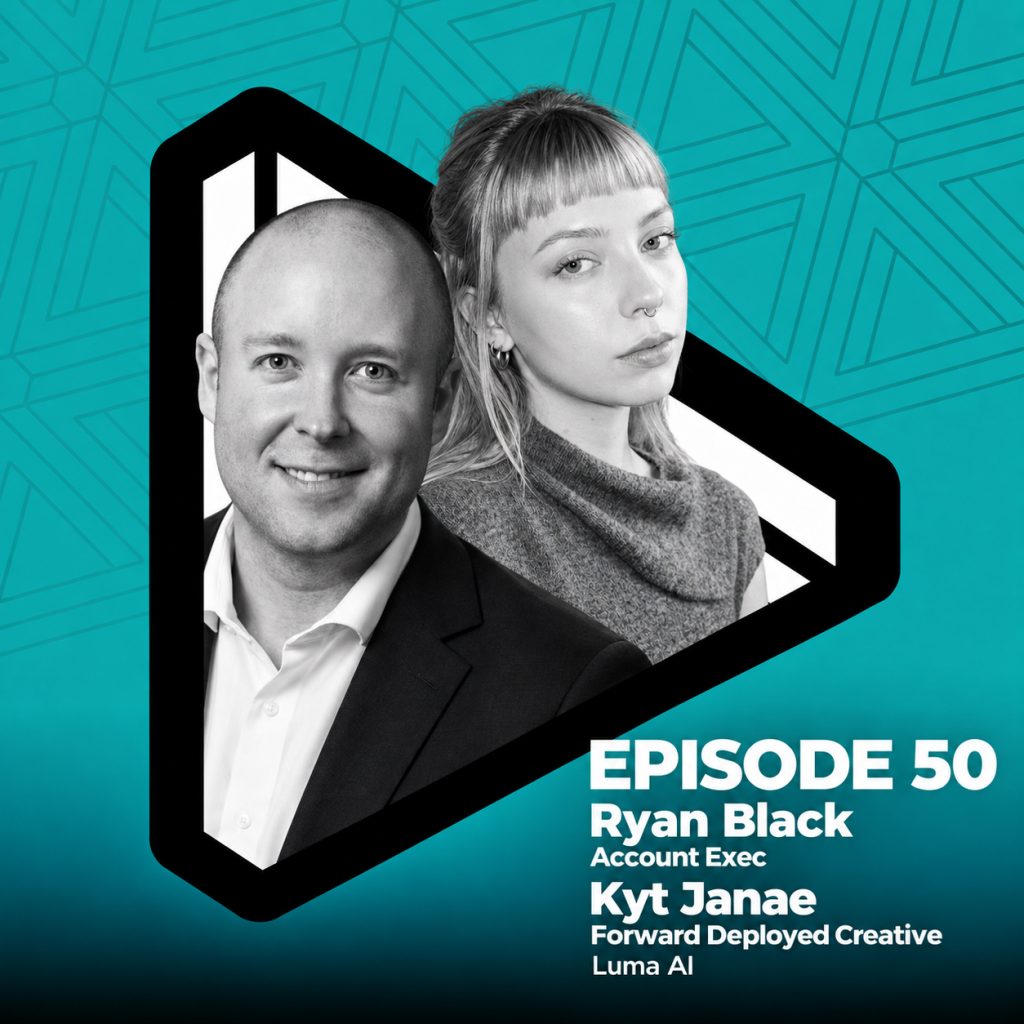
In this episode of Technically Creative, Orlando Wood sits down with Ryan Black, Media and Entertainment Account Executive at Luma AI, and Kyt Janae, Forward Deployed Creative at Luma, to explore how generative AI is transforming professional filmmaking, advertising, visual effects, and the way creative teams bring ideas to life.
Ryan and Kyt explain how Luma is evolving beyond AI image and video generation into a platform built around professional creative workflows. The conversation explores Luma Agents, a multimodal creative platform that brings together different AI models, tools, and workflows, alongside Luma’s unusual approach to helping companies adopt the technology through Forward Deployed Creatives. These experienced creative professionals work directly with studios, agencies, and production teams to integrate AI into existing processes, combining technical expertise with a deep understanding of how creative work actually gets made.
They also examine how AI is changing the relationship between pre-production, production, and post-production. From AI-assisted storyboarding, visual effects, and character consistency to hybrid filmmaking with real actors, motion capture, virtual production, and generative AI, Ryan and Kyt discuss how these technologies are allowing creative teams to work more collaboratively and explore possibilities that would previously have been too expensive or complicated. The conversation includes Luma’s work with AWS, Jon Erwin, and Wonder Project, as well as Robert Rodriguez’s experiments with using AI to develop creative ideas he has carried for decades.
More broadly, Orlando, Ryan, and Kyt discuss what these changes mean for the future of professional creativity. How do filmmakers maintain creative control as AI becomes part of the production process? What happens when directors can explore hundreds of possibilities before committing to a final approach? And how can studios and creative companies introduce these technologies while preserving the experience, judgment, and craftsmanship of their teams? It is a conversation about AI as creative infrastructure, the emergence of entirely new production workflows, and why human creativity and professional expertise may become even more valuable as the technology evolves.
Watch the conversation
Ryan and Kyt Explore
- How Luma AI is transforming professional filmmaking, advertising, and visual effects through generative AI and agent-based creative workflows
- What Luma Agents are and how they bring together multiple AI models to give creative teams greater control, consistency, and flexibility
- Why Luma is deploying experienced creative professionals directly into studios and agencies to help integrate AI into existing production workflows
- How hybrid filmmaking is bringing pre-production, production, and post-production closer together through AI, virtual production, motion capture, and real-time collaboration
- How filmmakers like Jon Erwin and Robert Rodriguez are using AI to explore new creative possibilities and bring ambitious ideas to life
- Why human creativity, professional experience, and artistic judgment become increasingly valuable as AI changes how films, advertising, and entertainment are made
Chapter markers
- [00:00] Introduction: Luma AI, Ryan Black, Kyt Janae, and the future of filmmaking
- [01:14] Luma Agents, Ray 3.2, and the new AI creative platform
- [03:36] How Luma is building AI tools for professional creative workflows
- [04:24] Why Luma uses Forward Deployed Creatives to help companies adopt AI
- [07:49] What is a Forward Deployed Creative?
- [09:44] How Luma integrates AI into advertising, VFX, and film production
- [11:40] Creative-led, AI-assisted: Luma’s approach to human creativity
- [13:21] Why experienced creative professionals have an advantage with AI
- [15:32] Professional filmmaking requirements: 4K, EXR files, and color control
- [16:15] Why creative control and consistency matter in AI production
- [18:07] Luma Agents explained: Multimodal canvases and AI workflows
- [20:00] How multiple AI agents collaborate on creative projects
- [21:45] Exploring hundreds of creative possibilities with generative AI
- [23:24] Character consistency, reference images, and alternatives to LoRA models
- [24:15] How AI is transforming VFX, rotoscoping, and compositing
- [26:21] How advertising agencies and Hollywood studios are adopting Luma
- [27:33] Jon Erwin, Wonder Project, and the future of hybrid filmmaking
- [28:39] Inside the AWS and Luma hybrid production with Ben Kingsley
- [30:13] Combining motion capture, virtual production, and generative AI
- [31:54] Can AI make previously unproduced Hollywood scripts possible?
- [34:03] How AI is making ambitious creative ideas more achievable
- [35:17] Faster visual effects and creative decisions on film sets
- [37:23] Why AI could unlock a new generation of filmmakers
- [39:41] Luma’s partnership with AWS and Project Nara
- [41:35] Amazon MGM’s growing commitment to AI-assisted filmmaking
- [43:43] Hollywood’s history of technological disruption and reinvention
- [47:15] Where AI fits into pre-production, production, and post-production
- [49:30] Why Hollywood is starting with AI previs and VFX workflows
- [51:14] Will AI replace traditional post-production companies?
- [53:35] Robert Rodriguez and using AI to bring decades-old ideas to life
- [57:17] Luma vs. Runway, Higgsfield, and the AI video platform competition
Transcript
Read the transcript Show
Orlando (00:02) Sure. Kid, sorry. Kid. Awesome.
Okay, tremendous. Great. All right, Ryan and Kit, thank you guys for doing this. I’m really excited. I love Luma. I love what you guys are doing, and I can’t wait to dig into everything you’re up to. so thanks for joining me on the podcast.
Ryan Black (00:27) Thanks for having us. Very exciting.
Orlando (00:30) Great. Well, keen to dig into it. Ryan, you are the an account exec in charge of media and entertainment for Luma. Kit Janae, you are a Ford deployed creative, which I’m very excited to get into what that means for the people that you work with. but yeah, this is this is great. I wanna start with, for somebody who’s knows Luma a little bit from the outside, just as a kind of image model that generates great, great,
you highly well produced AI video. What do they need to understand about what Luma is today, what each of you does, and the creative problem that you guys are solving today?
Ryan Black (01:14) Yeah, I think well, outside of just the the
Great image model that we have, which is Uni One, and and the great video model that we have, Ray 3.2. the main the main thing that maybe not everyone quite knows yet is about our our new Luma platform with Luma agents. And and and what that is is basically it’s it’s bringing in not only those those great our flagship offerings, but it’s also bringing in a lot of other third-party APIs, such as
Nano
Banana on the image side of things, such as VO3 on the video side of things, Cling, C Dance, etc. as well as 11 labs for audio solutions. So it is really a one stop shop as far as having all the great models available within that platform, but but really the the secret sauce, so to speak, lies in the Luma agents. So it think of that as basically having you
know a Claude a chat GPT this this great assistant there helping you to iterate and ideate and be able to help bring your vision to to life and and being able to do it very quickly and efficiently and so so that is is the Luma platform with Luma agents and we’re yeah we’re having a lot of really great success with that and a lot of very satisfied customers and it looks like we
Lost kit.
Orlando (02:48) Fantastic. Yeah, let’s let’s pause for a second. there she is.
kyt (03:00) Wi-Fi network so that that won’t happen again. So sorry about that. My
Orlando (03:01) Okay. Okay, no problem.
kyt (03:04) house Wi-Fi
Ryan Black (03:04) No worries.
kyt (03:04) is being a little weird. okay. Should we do we jump back in? It’s the best way. Yeah.
Ryan Black (03:09) yeah. All good. So
Orlando (03:09) Yes, absolutely.
Ryan Black (03:12) yeah, I I just explained a little bit about the the platform and and the different offerings within that. But mainly
Orlando (03:16) Yeah. Yeah.
Ryan Black (03:18) the secret sauce kit, and I’ll let you dive into a lot of this is w lies within the Luma agents and and being able to utilize those agents to to help iterate ninety-eight and create workflows and yeah, it’s really exciting stuff.
kyt (03:31) Yeah, so go ahead. I’ll talk about agents eventually. I was just gonna
Orlando (03:31) Yeah. No, please go ahead. No, go for it.
kyt (03:36) say, yeah, that’s one of the really special things about Luma. We have three core things going for us right now. We’re consistently and have always been a foundational model company research lab. so we have our Uni One and Ray 32, as Ryan said. then our brand new Luma Agents product, which is this intense multimodal boundless canvas, allows you to generate at really high scale.
and is really purpose built for creative workflows, but across many industries. So it eats advertising and marketing and brands for breakfast. Of course, it allows you to be incredibly prolific and certain. It’s also incredible for media production. And maybe the third thing is like the forward deployed creative, which is a pretty unique and forward deployed engineers, which is a pretty unique business model to Luma and is championing the adoption a lot of these
Orlando (04:23) Yeah.
kyt (04:23) tools.
Ryan Black (04:24) And and Kit is one of our rock star FDC members. And so so what’s really special about this is is having someone there we we take customer success in education very seriously, the company’s a technology and an education company at heart and so just ensuring that our customers are having a great experience and learning how to use the tools to their fullest capabilities and being able to deploy our FDC team such as Kit.
and and have her and her team there to to help demonstrate how to to utilize the tools and help to troubleshoot on different problems that people may be running into. It’s it it it’s something that I think is r really sets us apart as as far as some of the other folks in this space.
Orlando (05:16) that yeah, I I I think that that’s you’ve hit the nail on the head because I think that it seems to me there’s there’s a lot of there was a lot of interest initially around these these image models. And then very quickly you became, or not you became, but everyone who had an image model became one of many image models. And each one did certain things better. And then, we reached a point where there’s a professionalism across all of them where
The incremental differences between what a Nano Banana does well versus what a Ray does well is, and they clearly have their specialisms that they’re better at, but it’s it’s really incremental now. and I think that what’s so interesting is that you’ve taken the view that the work stream and and training up between your your platform and the floor deployed creatives, that it’s actually the work stream and training up the clients of yours in the work stream.
To show them how to do this and just deploy it across multiple creative outlets is really unique. I think a really it makes people feel really comfortable jumping into AI. Ryan, you and I have had conversations about, brands that wanna train on their product and have that all set up. And what we really liked about what you way, the way you guys came at it.
Was it was a holistic approach. It was not like here’s a platform, you’ll figure it out in six weeks and and you’ll either sink or swim. There was a real hand holding of we get it, this is all new. Loads of professionals forever who have done this are still coming to this new, and we’ve got to be part of helping people.
Ryan Black (06:56) Yeah.
Yeah, absolutely. it’s in I’m gonna let Kit kinda really dive into, the specific model training or LoRa esque aspects of of it. But but yeah, so i as far as being able to ensure that the the client is is learning how to fully use these tools, yeah. I the idea is to be able to set you up for success, create help create different workflows and pipelines that are going to to to basically become like rinse and repeat now.
we’ve taught you the fundamentals, now you know how do this. Now hopefully, when it comes to certain brands or whatever the the case may be, hopefully now they know how to do that for for a lot of their clients. And and on the film side of things there’s just there’s so many applications and we’ll dive into that I’m sure later on, but I’m gonna let Kit chat a bit more about the specific model creation.
kyt (07:49) Well, yeah, there’s a few there’s a few layers to it. I think it’s important to have some context on FDC too, these forward deployed creatives, because it one, it sounds very San Francisco as a title. Whenever I tell people that I’m a forward deployed creative, they’re like, Well, what the heck is that even? And
Orlando (08:00) Yeah. Yeah.
kyt (08:03) where are you deployed to? And and and it’s also like a really unique team and a net new idea. This is an idea that maybe couldn’t have existed twelve months ago or sixteen months ago. FDC is a really unique team at
Orlando (08:15) And it’s similar to the
idea of a Ford deployed engineer. So companies like Palantir will put an
kyt (08:18) Yeah, right.
Orlando (08:20) engineer on your business, you’re paying for a certain portion of their time and they’re developing bespoke products for you. You guys have taken
kyt (08:26) Exactly.
Orlando (08:27) that and gone, no, actually, we can have Ford deployed creatives who really know our workflow and really know our models so well and that can help people, apply AI into their business. Is that a fair assessment?
kyt (08:40) That’s that’s that’s very much what it is. And it’s actually not that much of a net new idea. And a lot of the things that you’ll see, especially when we move through entertainment and media, are like us pulling on traditional experience to guide a pathway forward into this new world. It used to be called a a field, a field engineer was like the term before forward deployed engineering and before Palantir owned that. But it’s the same idea of like you’re deployed, you’re sent into these situations. Now my team itself is really unique.
we’re all from different walks of life with ranging amounts of decades of experience. I came from running my own studio in Los Angeles for 10 years. I worked in traditional animation, a lot of cinema 4D, but also BFX compositing for features, worked on stuff like Rick and Morty. and I’ve did that for 10 years. I tell people I play it paid in blood, sweat, and tears in terms of traditional pipelines. But I’ve spent the last five as a creative researcher, the last four months of those five years at Luma. So it’s still pretty new.
Though that’s long for AI time. That’s already a decade because so much changes so fast. but
Orlando (09:41) yeah.
kyt (09:44) a lot of our team is like that, right? They come from agencies, they’ve worked with really big brands, they’ve worked across all these different teams. So we have all this real world experience of we already know how these teams work and we specialize in different things. And so our when we get deployed, when we start to work with these sort of enterprise clients, what happens is we come in and we like
try to do our best to understand what the not only what they’re making, but what is so painful what’s the most painful parts of it right now? Is it the lack of is it the turnaround times to see things, to see variations? Is it a lack, is it the the scaling of things? We have a lot of stuff we work on with regionalization and localization. or is it more of like you want to be able to iterate faster or you want to be able to empower your teams to move faster? And so the first thing we do is we assess and then we start to work with
Team to build these custom workflows to eliminate the most painful parts and unlock whatever’s most creative. And education happens alongside that. And then hopefully, the goal is that you start to get really excited about the tools too. You start to it’s a big
Orlando (10:47) Uh-huh.
kyt (10:47) philosoph philosophy shift alongside an actual technical
Orlando (10:50) Yeah.
kyt (10:50) shift, right? Because we’re always working with people, we’re training and working with people who have all already been career creatives. sometimes in the VFX world, I’m talking to people who are like,
so legendary and have made films that I like grew up watching and dreaming of being able to work on something of that scale.
Orlando (11:02) Hmm. Yeah.
kyt (11:06) So the the the skills are all there. The the creative thinking, which is what matters the most in this moment, is there. And we’re just reshaping some of the philosophy, trying to translating these things over. And then most of the time people have so much fun and they’re so energized by it. They’re so
Orlando (11:21) Yeah.
kyt (11:21) liberated in these new ways that we don’t really have to keep training. They embrace it, but we come back and visit when we have a new model out and
new fun things to show. and to do
Orlando (11:29) Right.
kyt (11:32) some troubleshooting when it’s needed. So that’s our team. It’s really unique.
Orlando (11:35) Mm-hmm.
kyt (11:37) and we’re busy, really busy all the time. It never stops.
Orlando (11:38) Yeah, I bet.
Ryan Black (11:40) Yeah.
Just to touch on something that the kit mentioned, as far as that creative thinking and empowering those teams. I I I it’s really important to make that distinction. this is very much we look at it very much like, creative led, and AI assisted in in in really keeping your your creative team intact. And we’re not not trying to go in there and just it’s a one button prompt or something like that, and you and you get a
a movie. that it some people have the wrong impression as as to what the goal is, I think, with some of these AI tools. And it and it’s really to help empower and and assist creatives to to achieve their vision. So, a as opposed to replacing those creatives. That’s just wanted to point out. Yeah.
kyt (12:28) Well yeah.
Orlando (12:29) Yeah. Yeah,
kyt (12:31) If it was
Orlando (12:31) a hundred percent.
I think that, Kit, you you talked about professional workflows. And I think that’s very much what we focus there. Our audience is mostly creative professionals who are working in organizations that have been, producing media at a very high level for a very long time. And specificity and co control, context, continuity, collaboration and deployment, those are the realities of a
professional workflow. And you can’t just generate your way or prompt your way into that. And I think that that’s what I find so unique about you guys is that you’re, you’re, you’re joining that workflow collaboration with the Ford Deployed Creatives to just teach people a new way of doing it, and I think that that’s really interesting.
kyt (13:21) Yeah, it’s it’s a super interesting philosophy shift. I there’s if it was one click, we wouldn’t need forward-deployed creatives. But the reality is that the tools have changed and there are parts that have gotten a lot easier that eliminate a lot of these common pain points, regardless of what you’re working on. And all those creative skills that you’ve built in your career translate over quite well. In fact, the thing that wins in this next moment is your creativity. It’s like
The very ideas that you have. It’s the thing the model actually can’t make, which is the new idea. and so we we actually have a lot of fun, and it ends up being this really interesting philosophy shift to take our previous experience and start tooling it towards this new world. Even small things that feel insignificant but end up becoming these big philosophical building blocks, like the the absence of project files, right?
we’re working with teams who are normally working in 3D files and meshes and rigs or complex Photoshop layers. And there’s also this really interesting handoff in that philosophy shift where we’re obviously trying to guide or are guiding them on this bridge towards this new world, but we’re also learning a ton about what they actually need in their creative tools. That’s something that’s also super
Orlando (14:34) Mm. Yeah.
kyt (14:35) unique about Luma. So we’re growing really quickly.
We’re at about 200 people. 25% of Luma’s staff comes from creative roles, career creative roles, and serves in creative roles currently. Some of that’s more technical, FDCs and technical artists. Some of that’s more on the brand side, marketing, a ton of designers. But Luma is really truly built by and for creatives.
Orlando (14:58) Yeah.
kyt (14:59) And so the other half of that equation with FDCs is like,
we’re in the field talking to these teams and they’re coming back and saying, No, I actually still do think in layers. I actually still do think in 3D models. And we go, that’s awesome.
Orlando (15:10) Yeah.
kyt (15:10) We’re taking that back to research. And so it
Orlando (15:12) Yeah.
kyt (15:12) creates this really cool flywheel where we actually do build things people need that actually do make their creative work better.
Orlando (15:17) Mm-hmm. Yeah. Yeah.
kyt (15:20) without anyone feeling, yeah, replaced or lost in the kind of whirlwind of change.
Orlando (15:25) Yeah, and that’s
Ryan Black (15:26) Yeah, we
Orlando (15:27) sorry, go ahead, go ahead, Ryan.
Ryan Black (15:29) No, no, no. sorry to interrupt you, Orlando. I was just I was just gonna
Orlando (15:31) No, I’m pleased.
it’s we’re here.
Ryan Black (15:32) To emphasize that point,
we that we take that kind of creative feedback very seriously. it as we’re talking to these professionals, in the film world, it’s very important for editors to have an HDR EXR file, for example. And that’s that’s something that I I believe we’re still the only company that’s offering that. at least we were as of a couple weeks ago. so that that’s directly from feedback that we’re getting from, editors and VFX post production.
houses, how important it is to have those exr files up to 4K resolution, 16-bit color space, and and things that are really important when it comes to professional level filmmaking tools.
Orlando (16:15) Yeah, and and a huge part of the professional process is the approval process. the I always I looked at, generative output and I was like, when does a brand get to input? And is it between the prompt and the output? When does the brand get to raise their hand and go, I want the production design to look more like my brand colors, et cetera, et cetera? And I think that that’s that level of both specificity and control I think is so necessary. you guys mentioned, in the the
Post-production were world as well. I think that, one of the things that I said to to Darren O’Kelly at Untold Studios, I was like, listen, I think that your pr workflow probably hasn’t changed that much, in as much as for years, anytime a new plugin would come out that dealt with hair or mud or wind or particles, you had to work that into your workflow. And that was a new way of doing things. So actually, yes, it’s happening at a lot faster speed now.
But really, you’re just still responding to new tools that are out there that can take some part of the process. And post-production is still a thousand-step process that you have to work through and you’re constantly tweaking. what I think is interesting about what you guys have done is you seem to have killed the Laura. The Laura had this moment of a year and a half to two years where all post-production people were like, there’s these low-rank models that you would train that would handle your post-product your
your production design, or they would handle your characters, and that’s how people got character consistency. But you guys have introduced the idea of agents, which it seems to me have killed the idea of Laura’s. That’s now gone. That’s a term we’ll never hear again after this podcast, I don’t think. and then you’ve it you’ve added this agentic layer in what seems to be a node-based system. Can you just explain to people what that is and and how it works?
kyt (18:07) Absolutely. I would love to. So yeah, the Laura’s the Laura question’s a good one too. Lowering adaptations. So, okay, so first of all, Luma agents, what is it? So if you’re familiar with a boundless canvas, if you’ve used Figma or Miro, put yourself in that headspace. It’s it’s this space that can go on forever. It’s akin to my favorite type of physical version of this is the gridded notebook. I carry one all the time. I know Ryan’s
Orlando (18:33) Yeah. Yeah.
kyt (18:35) a big notebook guy too.
so it’s like that. It’s like this boundless sketch space. you go lines. Wow. actually I really
Orlando (18:37) you’ll hate me. I go completely, completely lineless. No, no, no, zero lines.
Ryan Black (18:41) Ha ha.
kyt (18:43) that I really admire because it takes a degree of pers like personal precision to maintain a notebook like that.
Orlando (18:48) Yeah, yeah.
kyt (18:49) I have to have the grids or it gets crazy. so okay, so you have this boundless canvas, right?
Orlando (18:52) Yeah. Yeah.
kyt (18:54) And then if you are comfortable or or familiar with any large language model you’ve talked to, like a chat, GPT, a claude, it’s like those two things had a baby. And so
You have this little chat input, but you can actually chat anywhere on the canvas. And then you can put anything you want into that canvas. Now that recipe actually became essential for this spicier take about where LoRa’s go in the future. Because what’s really unique about that is most of these interfaces that you use, right? You have your little handful of references, which probably are swimming in your download folder because there’s no file system here. So you’re like dragging those in and then you’re like going through notes and pasting your old prompt in or trying to find it.
And then you run and then you wait, you wait, and then you get four things back, four variations of the prompt, and you’re like, you have to start that over and over again. And maybe something’s good, and then you download it and it’s back in the downloads folder, and then you go to a different website and upload it. You know what I’m saying? It becomes this
Orlando (19:46) Mm-hmm.
kyt (19:49) clown show of like, I’m living and dying in my downloads folder, and my stuff is not consistent. Exactly. And I still have no files. I it’s
Orlando (19:51) Yeah. Yeah. Just entropy, just creative entropy. Yeah. Yeah.
kyt (20:00) really it doesn’t I say this to the VFX world all the time.
MP4s feel unserious. a lot of this workflow just doesn’t feel like it meets me where I’m at for something that requires so much iteration. And so what’s really happening in Luma agents is we actually don’t have one agent. It’s more like 30 agents in a trench coat. And they all have superpowers, right? Some are really good at vision, some are really good at audio, some are really good at reasoning, some are incredible planners, some are more like workhorses and good at executing. And so what you can do with this canvas is anything you have, like a PDF, a
crazy email from your boss, a folder of just 300 unsorted images, a video. You can just put it all in there and that starts as your base. But also if you’re more organized and you have a brand Bible or a guideline or any of that stuff, that goes in there too.
Orlando (20:45) Mm-hmm. Yeah. Yeah.
kyt (20:48) And then the agent can see everything that exists in the canvas. You can obviously direct its attention at specific things. And so this magical combination of a very hyper intelligent, we call it a very, very smart intern.
With these many eyes and ears, and then all of this context, it breaks this world of okay, what’s my input? What’s my output? And so a lot of things start to change. One, you’re not reprompting stuff over and over again. You’re not reminding the tool what it’s working on, it knows what it’s working on. Two, you’re not bound to one to four outputs out. So we see teams work in scale. And I think this is also a really big thing that’s super misunderstood about these tools, right? You hear people say, I just want,
Or the fear is this one-shot answer to things. This I’m gonna
Orlando (21:30) Right.
kyt (21:30) write the perfect prompt, and that’s the new Marvel movie. It comes out on the other end. And that it’ll never be like that because the craftsmen in that industry are way too good for it to ever go there. And people like Ryan and I are fighting for tools to go in that direction too. But the
Orlando (21:43) Yeah. Right.
kyt (21:45) other thing is the magic of this tool is the certainty, right? It’s the ability to see many, many, many almost infinite realities and know for certain that you’re landing on the right one. In traditional VFX
Orlando (21:56) Yeah.
kyt (21:56) world,
You’re talking about thousands and thousands of dollars, hours, months, weeks. Here it’s like you just tell the agent, here’s my twenty variations, run each five times, boom, I see this whole world. And so coming back to your big time.
Orlando (22:09) So you multi execute. So the agents multi execute.
You then get basically a mood board of what your options it can become. Right. God, amazing. Yeah.
kyt (22:16) Anything, all your options. Yeah. Then you pick one, you start to dig
into that direction, and you can do the same thing with video, right? Because we say make great image keyframes, that turns into really good video. And so you can start to think in this way bigger, more liberated scale in those early iteration steps, so for certain where you’re going. And then that same framework works for consistency, which is like it’s a really funny philosophical shift too, right? all these original digital tools were all about.
actually you start from super consistency. How do you figure out to liberate the tool? AI is you start from everything. How do I get it to my consistent focused point? So we do the same thing, right? We have this giant endless sandbox of context. We can build these things where we like take character images and the agent writes a little text doc about what those images are. And that becomes what we call a lookup table. It’s like a little frame that the care that the agent can look at and has the images in it. And it can do that for props, for environments, for characters, whatever.
And you can combine a bunch of them together. So instead of having Laura’s that you’re training and calling and trying to make sure they’re okay, you just have these Legos that you can okay,
Orlando (23:23) Mm-hmm.
kyt (23:24) here’s my lookup table for my environment, here’s my three characters, here’s a PDF of 20 ideas I wrote out. Can I just see them? And it’s like,
Orlando (23:31) Mm-hmm.
kyt (23:32) you go refill your coffee cup and you come back and those options are there. It’s really cool. It’s pretty crazy.
Orlando (23:36) Wow. Yeah, that’s amazing.
Yeah, yeah. That that does sound pretty crazy. and we’ve I I’ve seen it, demoed and in action, and it is it is mind blowing. obviously I’m looking at it as a as as a client, I’m not actually the creator. But for you, as somebody who’s getting your hands dirty and that has worked in previous workflows that are, that are the I I don’t want to say obsolete, but they are the
kyt (24:06) No, not
at all.
Orlando (24:07) the but they are the workflows that we’ve, built these industries on. That must be incredibly liberating and exciting.
kyt (24:15) It’s really fun. There’s a bunch of stuff that was deemed impossible or drove my freelance studio or my personal studio crazy a couple
Orlando (24:24) Mm.
kyt (24:24) of years ago that now just feel like these magic tricks. some really insane stuff, realizing how easy masking and rotoscoping, really just small stuff that felt really time
Orlando (24:33) Yeah. Yeah.
kyt (24:35) consuming, but not just masking and rotoscoping, but the ability to put in our shot and just create a clean background plate for it. just really small stuff that goes into compositing.
Orlando (24:40) Mm. Yeah. Yeah.
kyt (24:45) but also just I think about all the times that I was on on a big project, we were already crunching, working late, and someone, a director would come back and be like, I want to see this scene from a different angle. And we’re like, We’re in 3D, and that’s totally possible. But when you think about re-keyframing it and thinking about render
Orlando (25:00) Yeah.
kyt (25:01) times and all of that execution, this is where yeah. Exact my god, yeah, I didn’t map that side or I didn’t rig that side. And it’s
Orlando (25:03) Texture and lighting. It’s not textured on that side. Sorry. or yeah, yeah. Yeah. Yeah. Yeah.
kyt (25:09) like this is where
Creative teams also fall apart. It’s when you have that guy who gets sent into the hole to work on the reshoot for a week and a half and he comes back just completely battle torn and fried and the shot’s not right. that we can make that whole team so much happier and we can get towards that shot at a fraction of the cost and still keep and retain all of your creative control and all of that craftsmanship. And I think that’s a moment that this industry really needs. You you want people to be empowered, less no’s and more yeses,
Orlando (25:37) Yeah. Mm-hmm.
Ryan, obviously, talking to kid, I I really see the point of this Ford deployed creative situation. and it’s it, are entertainment companies and advertisers, are they just loving this model? cause they get new tech without having to completely rework their own brain out of their current process. They get to learn and they get to the
the the knowledge of somebody like Kit on a project and they can learn from them. is this just blowing their minds? Is this, is this a huge part of of the offering now? And and are people falling all over themselves?
Ryan Black (26:21) Yes, they really are.
I I think, we’ve got some really great partnerships like public partnerships that we can talk about on the the ads and brands and commercial side of things. service plan, publicis, a couple of the the bigger, agencies out there. they’re they’re really embracing these these tools for their workflows and and being able to Kit touched on the the ideation and iteration in in finding, just dozens, hundreds of of
versions of whatever the particular product may be that they’re trying to to figure out how how does this look in this setting with this with this character and and this color you could it’s just infinite that all the changes that you can can look at very quickly and and decide which creative direction you want to take with it. I I think they were maybe a little bit quicker to adopt in that in that space than than Hollywood and and filmmakers and but
But I I think it it’s really been
I think this year is in in particular, we’ve seen that that tide is definitely turning. And I think
Orlando (27:32) Yeah.
Ryan Black (27:33) with with some very prolific and and and great filmmakers out there who are really starting to embrace these tools. we we have we’re we’re thrilled about the partnership that we have with John Irwin and the Wonder Project. Innovative Dreams is the name of that new collaboration. And and John is just such an incredible filmmaker and and trailblazer when it comes to looking
at how these tools can be implemented into in into what he calls a hybrid production. And so he’s still he’s still shooting with physical actors with hundreds of people on his crew and
Orlando (28:08) Mm-hmm.
Ryan Black (28:09) and shooting on large volume stages here in LA and and and I think that with with studios being able to look at a major filmmaker like that who’s utilizing these these tools is certainly helping to
certainly helping to to bring that conversation more into the forefront. And s speaking of J John and, so Amazon where his his series House of David and the Moses the old stories is is playing, they’re yeah.
Orlando (28:39) Can I just can I just interject quickly
just to say, okay, so the Wonder Project is a what’s what’s being her heralded as the first high true hybrid production. And you guys did it with AWS and John and it starred Ben Kingsley. And and it’s it’s basically using, it’s basically pushing all together the entire pre-production, production, and post-production process. So literally there will be
Post production personnel, your editor, your your
Your your mat artists, all of that, off to the side. And you’re literally able to have a conversation with them to be able to say, I think we need a shot. We we missed a shot here. Can we set the sun at 3:15 p.m.? We’ll set it there and then let’s let’s cover this off. And what’s really interesting is the first thing that I’ve seen that seems so collaborative, that you really saw all the conversations as a producer or director that you tend to have in sequence throughout a production process.
You get to have all collaboratively on the day. And that was very exciting. So yeah, I just wanted to set that stage for people who might not know what you’re specifically referring to, but shot on a volume stage, a lot of the backgrounds are pre-rigged, and then AI can be used to augment them. And then you have real actors interacting and with sets in the middle of that volume stage, performing and and true hybrid production done in two weeks.
Ryan Black (30:13) Yeah, that’s right. And the way that one way to look at it, the way that job d John describes it is so it’s motion capture and in the way that in the way that James Cameron would have done Avatar and it’s and also virtual production in in the vein of the way that the Mandalorian has been shot and combining the two of those in to to create this new hybrid approach. And and yeah, you’re absolutely right, Orlando. You can have, whether it’s like your editor or
Or whoever it may be who’s who can just raise their hand and say, Hey guys, we really need to get this shot in order to, in order to ensure that this is gonna flow properly. And they’re able to literally do it,
real time might be, not exactly accurate, but very, very quickly they’re on set within, within minutes kind of thing and make that change and
Orlando (31:05) Yeah.
Ryan Black (31:05) adjustment. so that that’s one way that it’s it’s these tools are being embraced. And I we’re most studios and streamers and in and a lot of a lot of post production and VFX houses are are all starting to really embrace these tools. I think, again further further to the point
I made earlier, it’s not about getting rid of these of these traditional legacy ways of doing things. It’s about how to find efficiencies and to to be able to do more
Orlando (31:38) Yeah.
Ryan Black (31:39) with the same as opposed to do as much with less. I think that’s not a great way to look at it. It’s like, we’re able to get so much more, bigger sandbox to play in, with
Orlando (31:51) Yeah.
Ryan Black (31:52) what we normally would have been able to do.
Orlando (31:54) Well, my attitude is it creates a whole new class of production, and I think that, it used to be you were either making a big film or you were making nothing. And I do think that what’s interesting about this new hybrid production workflow is it makes it at a price point that a whole, if if only one percent of all the scripts that have ever been written in Hollywood have ever been made, that means there’s 99% of the scripts that have that have ever been written.
That now have another shot at at potentially being made. And especially if something like this is being made with Sir Ben Kingsley, an Oscar, winning actor, who said he loved it. He said that his mirror neurons, when the when the ocean came in, he was like, it was weird that my feet weren’t getting wet. And so, as
Ryan Black (32:36) Right.
Orlando (32:37) an actor,
kyt (32:37) Mm-hmm.
Orlando (32:37) that’s an incredibly rich environment in which to play. And so, sure, it has some drawbacks. you’re not gonna shoot a car chase, probably, but but
other things are are perfectly suited to that sort of
Ryan Black (32:53) Yeah, yeah, a hundred percent. And and the hybrid production on a volume stage is just one example of the, infinite ways that these tools can be used. And and the way you mentioned car chase. So my my background for fourteen years I worked in Lionsgate for a division called Grindstone doing acquisitions, development, production. And I I did I was on set for, probably fifty different movies in which we had to pull off this car a car chase on a a lower budget
Orlando (33:19) I’m sorry. They’re the most boring things to shoot
kyt (33:21) Thank you.
Orlando (33:22) in the world.
Yeah.
Ryan Black (33:23) Yeah, yeah, that could be a pain. And
i i in in for a lot of these indie films and lower budget films, it’s like, you you have an afternoon to pull off this car chase and and you may
Orlando (33:32) Yeah. Yeah.
Ryan Black (33:34) not have had the the time or the the budget to let let’s for example, you at the end of this car chase the car needs to, run into a building or a train or another car and blow up. But, you didn’t have the ability to do that before because of time or budgetary constraints. And that’s
Orlando (33:50) Yeah,
Ryan Black (33:52) something that we
can help with. So it’s like you still got
Orlando (33:54) Mm-hmm.
Ryan Black (33:55) your great action sequence. It’s just we can help to iterate on that and and get a little bit more bang for your box, so to speak.
kyt (34:03) Definitely. I think that’s that’s probably the most exciting part about this whole moment is and especially for creatives, and why why people like Ryan and I are at Luma, why Luma exists. It’s like there’s this fundamental misunderstanding and maybe a lot of fear around what these tools might be able to do or whose jobs they replace and change. but I think there’s another way to look at it where you realize that that there’s so much liberation and
And creativity in this moment, because this moment is for everyone who had an idea
Orlando (34:36) Mm.
kyt (34:36) that was told it’s too expensive, it’s too weird, it’s too niche, it’s too complicated, we can’t shoot this, we can’t fund this. and we can do so it is like it feels like magic sometimes what we can do in these workflows where we do truly preserve creativity, or we’ll run these workshops where we’ll literally use our iPhones and film very much with real people to preserve that camera control, to preserve that facial
Orlando (34:59) Yeah.
kyt (34:59) performance and acting.
just a small version of a car accident, even things where people are just seated in chairs and with the right camera work can bring it into something like Luma and we can make it feel and look very believable in a matter of minutes. And even just for pre-vis alone, that’s so insane and liberating. And then when you
Orlando (35:17) Yeah.
kyt (35:17) start to think about more of the really brutal parts of production, a really good example from the John Irwin Moses bit is the also the motion capture. So of course the hybrid stage, the XR stuff is super cool.
Getting that real time near real time feedback is amazing. But the other one is like that they were able to pre-vis and view actors in scenes with that would require full get up, full makeup, and also special effects on the face, special transformations. They’re able to film
Orlando (35:45) Yeah. Yeah.
kyt (35:47) that guy in plain clothes on the stage, pop it into Luma, process it, and within 10 minutes see that shot back. And so that’s also the other part that’s really interesting to me. It’s like all of a sudden.
Creativity and the communication of creativity, which is like what makes a production good, on s on actual set now moves really, really fast. That would have taken weeks before. So what happens
Orlando (36:06) Yeah. Yeah.
kyt (36:09) in creative performance? What happens in what’s possible to direct and actually make when that kind of thing exists now? It it’s this really exciting new pathway, I think. Yeah.
Orlando (36:19) Yeah,
I I think that, we’ve all seen it before in our careers where you often think, that creative who always gets a lot of work made, it’s not great work, but they’re great at selling it, and and they’re fantastic at that part of not actually that fantastic at making the thing. And you see wonderful creatives who are sweet or timid or whatever else, and they have wonderful ideas. And when they do make stuff, it’s incredible.
But it’s very rare that they get it away because it’s, it’s harder to sell. And I think that the more you you mentioned there, Kit, communicating creativity. And I think that that’s
kyt (36:56) Mm-hmm.
Orlando (36:56) what’s so unique about this. Now everybody has a bit the ability to communicate their creativity to somebody else. And you have zero excuse if it’s not good because you have post-production tools you’ve never had available to you before at a really reasonable price. You have the ability, whether it’s just a keyframe or whether it’s a
mock up of a of a sequence or something like that, you now have the ability to to show what you mean, what’s in your mind’s eye.
kyt (37:23) Yeah, I think liberating that is what honestly I never feel like I actually left the traditional tools or pipelines. I just felt a frustration between the latency of head and hand, the actual execution time of things. And
Orlando (37:35) Yeah. Yeah.
kyt (37:36) I feel also very strongly that there are so many great ideas trapped in minds who can’t execute or articulate them because they don’t have the means to have these super expensive tools or the years of education it takes to learn them and and there are other scrappy pathways, but this one
To me, it is just such an energizing and exciting one. And I think specifically for media and entertainment, the timing is perfect. It it they’re not slow. I don’t think they’re too late. I don’t think we’ve taken too long. I think we’ve worked really hard to get the tools ready for this moment. Oftentimes they’re not exciting, super sexy, crazy things. They’re exr files, they’re understanding color space for people,
Orlando (38:13) Yeah.
kyt (38:14) they’re things that actually slot into real production pipelines and make meaningful, beautiful things. And
And so I think in a lot of ways, this is the moment for the creatives. It’s taken a couple years. We’ve watched it come a little slowly. We’ve seen these primitive models evolve, but it’s about to hit that point where I think we’re gonna see a lot larger adoption, but I also think we’re gonna see a new class of creative emerge from this moment. truly in
Orlando (38:37) Mm. Yeah.
kyt (38:39) in a way what YouTube was supposed to be in 2008, 2006, and was, but at a way grander scale, at a way more cinematic and like.
expressive scale than what’s previously been possible. And that’s really exciting to me. I’m here for the Renaissance.
Orlando (38:51) Mm-hmm. Yeah.
Yeah, awesome. It’s what I loved about, and there was the AI on the lot conference that was held at MGM Studios. It was on the volume stage where, House of David was made. What was amazing to me is that, your creative director at Luma got up there and spoke alongside AWS. And AWS was talking about Project Nara, which is a workflow tool that they’re working on.
can you talk a little bit that about that relationship with AWS and what you’re learning from each other about how to do this at scale? How to, create workflows that that more than just one director, John Irwin, can can take advantage of.
Ryan Black (39:41) well I’m not sure how how much we can dive into that necessarily.
Orlando (39:44) Okay.
Ryan Black (39:45) I I I I will say, yeah, AWS is we we consider, a a very important great partner and we we we love we love that relationship with them in in particular,
how we’re we’re really testing out some of these new R and D things and new ways of of of these hybrid productions, et cetera, through the Innovative Dreams initiative. But I I’m not sure Kit maybe you have some insights on this on the neurospecific of it all, but I I’m not sure how how much we can dive into all that.
kyt (40:21) Yeah, I would just say that from an FDC perspective, it’s been really awesome to see Amazon be so curious and explorative with a lot of new technology. they’re really open to embracing it. And I think in physical ways too, even just facilitating that entire Wonder Shoot Studios piece of the Moses show, and facilitating those kinds of productions in this world is like
Really it’s a really awesome thing to see any kind of support. Project Nara is obviously this bigger collaboration between Amazon Studios, Phoul, Luma. There’s a lot of really big players in it. and we’re excited to see what comes of it. and it’s been really fun to build with them, but we’ll have to keep the big secrets and surprises for another conversation.
Orlando (41:07) No, that’s that that’s totally
okay. Sorry, I didn’t mean to put you guys on the spot, but I just
kyt (41:11) That’s okay.
Orlando (41:11) what I do
Ryan Black (41:12) All good.
Orlando (41:12) think that that I saw that felt like a watershed moment a little bit at at AI on the lot was there’s been this kind of thing where everybody’s like, I we hate AI, but everybody comes back from the bathroom with really good ideas. And
Ryan Black (41:26) Yeah.
Orlando (41:27) so there was this period of time where everybody’s like, we don’t use it. No, of course we don’t use it, but look at this. And I think that.
kyt (41:31) Looking. Yeah. Yeah. Claude, what do I think
about this? Yeah.
Orlando (41:35) Yeah, yeah. And I think that
AWS or AWS Amazon MGM, which, we they are separate business units, but they they obviously, have a a need to be creating at a much brisker pace and and it and and finding new ways to use these things. What I thought was interesting is that they said, there’s this. We also have three more shows coming out this year, and they were somebody’s got to.
Put their head above the parapet and potentially get shot, right? and I what I think is great is that they did it and they just went,
Ryan Black (42:11) Yeah.
Orlando (42:13) we’re here, we’re doing it. some people are gonna be angry, some people are gonna be inspired. But, we worked with this guy, John Irwin, we worked with Luma Labs, we’re inspired by the way we get to use this. We can have multiple volume stages, we can have lots more productions happening. That’s gonna create more jobs, like it.
and and and create more people training for jobs and more fully deployed creatives. And it’s like there is a world in which this gets very exciting very fast, but somebody, you guys, AWS, has to say so out loud. And I was very encouraged by that. That that really felt inspiring,
Ryan Black (42:52) I I agree. I I think, AI on the law was i it it was such a
you you just really felt the shift, didn’t you? It was just like, okay, th this definitely feels like a moment in which, people are really ready to embrace these tools. And, not not just, technologists and, AI creators and stuff, but traditional filmmakers and and having, like Albert Chang’s keynote was was so inspiring and, just hearing a lot of, the the great insights that he and and his team have and and yeah, I I agree. it’s important
And Amazon’s definitely setting the pace when it comes to, just say, hey, we’re we’re in, it’s here and we’re we’re gonna we’re gonna make the we’re gonna really figure out how to utilize this to the to the fullest. And it I thought it was a great, great event. And and very excited about AWS.
Orlando (43:43) It also I
yeah, I think that the other thing is MGN, we also forget that that the slowness of 15 movies a year per studio is a new invention of Hollywood. back in the 30s and 40s, Hollywood was churning out productions. it was a real industry. it was, and granted, they weren’t treating artists that great, and every artist was under contract, and there were certain things that
kyt (44:10) Bad.
Orlando (44:11) that we’ve definitely improved.
But I think that,
kyt (44:13) Mm-hmm.
Orlando (44:14) the industrialization of Hollywood is more a part of Hollywood’s DNA. And MGM was the hero of that. it again didn’t work out great for Buster Keaton, but that is a feature of Hollywood,
kyt (44:26) Yeah.
Orlando (44:26) this this thing. And I I I see somebody like MGM or AWS and Amazon going back to that. And I go, yeah, they’re going back to their roots as MGM. And everybody’s like, well.
we want to go back to the eighties and that’s fine, so do I. But I also think we
kyt (44:43) Ha ha.
Orlando (44:43) can go back further and cherry pick the best parts of each decade as we look look over a hundred years of filmmaking. Sorry, there wasn’t a question
kyt (44:52) Yeah, I’m so glad you
Orlando (44:54) there.
kyt (44:54) No, I actually am really glad you brought that up because that’s I was thinking about that as you were talking. Specifically, I think one of the most interesting parts about this moment about Amazon adopt or it Amazon Studios adopting and creating these new shows is like it’s it feels very par for the course. And specifically bringing up the 1930s is really interesting to me because a hundred years ago ish in the 1930s, this same discourse played out in almost the same scale.
About automation of music, right? In theaters, initially, when theaters played films, you’d have a live band there, and they would do the score live in real time.
Orlando (45:26) Mm-hmm. Mm-hmm.
kyt (45:27) And at parties, you would have a live band. And there’s all this great, it’s like on the internet archive you can find it, but there’s all this great, scanned documented ephemera from that time. These incredible illustrations of these robots with phonographs for heads and musical notes coming out of their bodies, and these really amazing propaganda posters that are like the end of live music.
How dare you automate the thing that is the the most human thing of all? It brings us so much purpose. And people couldn’t imagine the cinema with a phonograph playing
Orlando (45:58) Yeah.
kyt (45:58) a record. how would that ever feel as alive? And I think that you watch that pattern play out over and over again, right? the same thing happened in production and animation in the nineties, early 2000s, with CGI coming into
Orlando (46:12) Yeah.
kyt (46:12) predominantly physical mediums of animation.
So it’s this really interesting cycle of technology that happens over and over again. Now we look back at those, and there’s so many things that have come, yes,
Orlando (46:19) Yeah. Same thing with television. When television came in, yeah.
kyt (46:24) big time, right? And you look back and there’s so much that’s good that’s come from recorded music and from the internet and from CGI. I would keep all those things now, but there were these sort of pioneers who had to take those first steps. And the only way we figured out how to use those tools effectively, how to make great CGI is like.
We did it. We tried it. And so that’s how I feel about this moment too. It’s like the tools aren’t going away. They exist. So I really admire people who are excited to at least try and see what’s possible. maybe it it’s isn’t like a one shot answer to everything, but it probably shouldn’t be anyway. So yeah,
Orlando (46:59) Yeah.
kyt (46:59) I don’t know. It’s it’s interesting. It’s such a cycle.
Orlando (47:02) Yeah, we don’t want everybody to end up like Norma Desmond. it’s there there are ways for, your amazing talent in silent films to transfer over into the talkies.
kyt (47:13) Exactly, exactly.
Orlando (47:15) so what I’d really like to get in, just as we wrap up a bit, is where does Luma most aptly fit in today? because obviously you can help at any part of the creative execution process, whether it’s creative development, whether it’s
print and internal studio stuff, that’s just prepping for, going off and doing a traditional photo still shoot down in, South Africa or a a feature film or doing taking away all the mood films. No more mood videos anymore. We’re gonna actually make you a mock-up of the ad, like a a an animatic, or there’s fully through to creative execution or
We’re gonna have our clients’ products all loaded into Luma, and that way we can drop them in anywhere. There seems to be multiple ways in. Do you have a path that you’re seeing with your clients that seems to be the best one? Is it best that they come to you and take baby steps and learn more? Or is it better that they come to you and go, we want an AI-assisted workflow all the way through to execution? Come in and let’s do this over the next four to six months.
Ryan Black (48:29) I I’ll I’ll let Kit weigh in on this as well. But my I I think it’s very case by case and client by client at at this stage. And for for some it is very much like a a c crawl, walk, run. Let’s let’s
Orlando (48:42) Mm-hmm.
Ryan Black (48:42) start, a little bit more like pre-production, previs, storyboarding or creating, more impressive decks and animatics as you as you mentioned, Orlando. being able to
Orlando (48:55) What’s the what’s the
version that’s gotten the most amount of value for the client, do you think? what what would be the the client trajectory or arc that you think that’s the best way to engage?
Ryan Black (49:08) I I think I think starting out i on the film side of things it’s a little different maybe than on the ads and brand side of things that are looking to,
to create, entire workflows to to really figure out how to to streamline a lot of the process right off the bat. I think, in
Orlando (49:27) Mm-hmm.
Ryan Black (49:30) in the film world, it just depends on who you’re talking to. But it’s a little bit easier conversation right now as as as I mentioned earlier. Hollywood’s a maybe a little slower to adopt to some of these new technologies. I think that’s just the the case for a lot of situations. But starting with pre-production or post-production
Production
is a little bit more palatable right now for a lot of folks. Where it’s one thing for us to say, yeah, you can do a lot of this within your actual production. I think that’s just takes a little bit more education and teaching folks how to actually implement that into their productions. And no one’s just gonna dive in right off the bat and say, yeah, I trust you. I don’t need to go shoot this scene with my actor or with this car chase or whatever.
Orlando (50:15) Right. Right.
Ryan Black (50:16) So it’s like what John is doing again is really blazing that trail.
And I think as we’re able to educate more people on how to do the actual production and hybrid production, I think that’s really gonna become a much bigger, more more steady occurrence. But right now, I think pre-production, pre-vis, and post-production stuff coming in and helping with traditional, whether it be like wire removal, set extension, map painting, beautification, product placement, all there’s just so many great use cases.
Orlando (50:51) So do you think you’re
kyt (50:51) Yeah.
Orlando (50:52) replacing the post production company, in in that pipeline for the agency, even if they’re doing stuff professionally, or or not professionally, but traditionally in like a shootout there and you’re going, Yeah, do the wire replacements with us. better to have your assets in our workflow so that we can be learning from them. And, is that true?
Ryan Black (51:14) I I think I think that a lot of post and VFX companies are wanting to implement these tools and are implementing them to figure out how to create, efficiencies
Orlando (51:20) Yeah. Mm-hmm.
Ryan Black (51:22) within their workflows. I don’t think it’s about you can do all your posts with with Luma’s platform right now. That’s definitely not the case. You could you
Orlando (51:27) Mm-hmm. Mm-hmm. Right.
Ryan Black (51:30) can do a lot of great stuff there and get you a lot further, a lot quicker, but I I I don’t think it’s about trying to replace the the post and VFX houses.
kyt (51:41) Yeah, we’ve we’ve we have had engineers flirt with the idea or maybe from first principles construct ideas that end up looking a lot like trying to rebuild After Effects or Nuke inside Luma agents and we’re just not that is a bridge we’re not ready to cross. but our tools
Orlando (51:57) Mm-hmm.
kyt (51:57) do end up in a lot of the hands of VFX and post production houses. they work with these agencies and work on these commercial spots. The agencies are more on the video tools for more of the previs ideation exploration.
of stuff. I think what’s really cool about a lot of what we’ve talked about today is a lot of it is available to just the average user right now. you can just log into Luma Labs. You can talk to the agent. We actually recommend starting with talking to the agent about almost anything you’re working on or trying to figure out. It’s really, really smart and really good at building that kind of stuff. so this democratization of these tools, it’s very much real and in this moment. In terms of for production and media and entertainment,
I, I always tell people the the things that people show up with, which is literally just like themselves, is is almost always more than what we need. It’s like you’ve got years of experience, you already know how to think a career creative. All of that is even more valuable here because the second most important thing is your actual creativity, your ideas, what you want to make or do or express. And both of those things, usually people have in droves who pick up these tools because they’ve already worked in cre creative fields, they’re already comfortable with that. And so they it’s just like
We’re more like gasoline in that sense. we’re just
Orlando (53:12) Yeah.
kyt (53:12) once you figure out how to move around our tool, you just explode and take off
Orlando (53:16) Yeah.
kyt (53:17) and and start to be really prolific, as we say. So yeah, I think it’s like there’s a bunch of different pathways in. It depends on the size of the thing you’re trying to figure out. But sometimes it’s just about picking it up and sometimes it’s about getting in touch with Ryan and getting an FDC deployed to your office.
Ryan Black (53:35) on I’m a
We haven’t necessarily touched on animation very much. but just one, fun story. So it I could talk about this because, he was publicly talking about it too at South by Southwest. We had this this great event at Troublemaker Studios with Robert Rodriguez and his team. Robert has been exploring these tools and he he’s looking at it i in a really cool way as far as being able to bring these ideas that he’s had for decades,
Orlando (54:05) Mm.
Ryan Black (54:05) like sketches, just
black and white sketches. He started out as creating cartoons for a a newspaper in his hometown. And being able to take these ideas that he’s had literally for, decades and being able to then plug those into our system and start iterating, ideating and and getting,
dozens, hundreds of versions to to be able to say, my God, that is exactly what I had in my mind that
Orlando (54:31) Mm-hmm.
Ryan Black (54:32) normally would have taken him months of going back and forth with with artists to try to figure out exactly what he had in mind for these these animated characters that he wanted to bring
Orlando (54:41) Yeah.
Ryan Black (54:41) to life. And and and seeing how excited he got about that and being able to bring his ideas to life like with it, within minutes, hours, w
Orlando (54:53) Yeah.
Ryan Black (54:53) was really cool. So
that that’s just one example of the way to to look at it from a ideation and and pre-production way to to whether it’s putting together pitch materials to then take to the studio and say, here’s the exact characters that I want to have in this film, or or just to to really get the the filmmaker the confidence level that they need to say, yes, this is this is a solution that can help me get my vision on screen. So
Orlando (55:21) Yeah.
Ryan Black (55:22) I thought I thought that
that was one of my highlights and favorite moments working at Luma for sure. I’m such a fan of Roberts and and
Orlando (55:29) Yeah. Yeah.
Ryan Black (55:30) have been for forever. And it’s just to see him getting excited about that. And someone coming from the traditional legacy way of making these films is really cool.
Orlando (55:38) Yeah.
Yeah. I was the moment you said Robert Rodriguez and and traditional ways of making films, like I was like, really? But no, I know exactly
Ryan Black (55:46) Yeah.
Orlando (55:49) what you mean. And that’s what, it’s like there’s there’s nobody with more cred that, the gorilla style, and and and I think that that that’s what’s so great. And somebody like him, ja that speaks to the the creative processes of professionals anyway. It’s like they have something in their mind they’re trying to get out.
And I think that what we see a lot is people standing next to a generative output and going, Yeah, I meant to do that. It’s like, no, you didn’t. You saw something of a bunch of generations that you eventually thought you would be happy to lend your name to, but you didn’t express what was in your mind’s eye. And I think it seems to me that you guys are solving for that, which is what professional creators need the most, which is specificity, permanence, this idea that you can have an idea, you can take your mood board, you can
You can adjust it until it really is exactly what you had in your head. And then you can create a permanence to that and have that ripple through shots and those sorts of things. And I think that’s really, when when Ryan, we’ve you first demoed some stuff that we were looking for a brand, I was like, My God, you really have nailed that thing of going, listen, we’re not doing this and not thinking about your brand or not thinking about your product, or not,
These agents are baking that into the process. And so, the
Ryan Black (57:09) That’s right.
Orlando (57:09) the the box you have to work in is is as defined as you need to make it.
Ryan Black (57:16) Absolutely. It’s No no no. Go ahead.
Orlando (57:17) Can I just sorry, go ahead?
can I just ask just one more thing? is is there because obviously Runway does it a certain way and and stable does it another way, and Higgsville does it another way, and your guys, and and is there a platform war happening? Is everybody vying to be the the Adobe, of the Adobe Photoshop of this world? Or is everybody going?
Hey, listen, use us, use them, what what’s how’s that in terms of the competition around the way these things work? it seems like you guys are out front, if for no other reason then I can have a forward-deployed creative tell me and show me how to, how to work with your platform.
kyt (58:07) I would say that Luma is we we have those other models in our tool. You can use Valeo, you can use Seed Dance in Luma agents. I don’t think we spend much time thinking too much about what other people are building, but I do think that it is an incredibly interesting and energizing moment to have so many teams on the forefront trying to solve these problems concurrently. but we really feel like we’re winning.
when we spend the most time talking to the people who use the tool or want to use the tool and less time like trying to look at the other stuff. So at least in FDC practice, Ryan might have a different answer, but we’ll try other tools just to get a feel for what’s possible, but but that’s about it. We don’t talk about it too much. What about you, Ryan?
Orlando (58:54) All right,
good.
Ryan Black (58:55) No, I I I think you really nailed it, kid. I I guess the only thing I I would add to that is, I I think at this point it’s just like
We want as many people utilizing our tools as possible and we think that they’re gonna speak for themselves. So therefore i offering our APIs to other some of the other folks that you mentioned, Orlando, Higgs Fields and et cetera, it’s like, hey, that’s fine. Then people on their platform are gonna be able to utilize Ray 3.2 and and they’re gonna be able to make their choice as to does this work better for me? And and our bet is that in a lot of cases, yes is gonna be the answer to that.
Especially when it comes to film quality, cinematic quality results and and being able to keep the consistency and being able to keep the the fidelity, etc. So I I think I I think, the competition is is is is fine for us. We we just want to get our our tools out there and and offer it up to as many people as possible.
Orlando (59:55) Yeah. Well, amazing guys. Thank you so much. for anybody, listening, my attitude is that, when it comes to seeing what’s out there from the model to the platform to the Ford Deployed Creative, I just think that you guys have really there’s no part of this, whether it’s film or advertising or design, that I’ve seen you guys miss in terms of knowledge or understanding. I think my attitude would be that if anybody can
is is unsure of where to start. I think that speaking to you guys is is exactly the place to start because I think that you have a really, really good grasp of the various, different industries that that need to be serviced with a tool like this.
Ryan Black (1:00:43) Well thank you, Orlando, and we really appreciate the opportunity to come on here and talk about Luma. And and congratulations to you and to Kubrick and with all your
Orlando (1:00:52) thanks.
Ryan Black (1:00:53) recent successes too. The what was it, the 40 over 40? That was really awesome. And
Orlando (1:00:55) Thank you. Yeah, I had to admit that I was over forty. I thought with this baby face I might get a few more years
of pretending to be thirty fi thirty-nine, but nope.
Ryan Black (1:01:07) Yeah. Well we we really appreciate the the vote of confidence and we look forward to to working with you and your team.
Orlando (1:01:14) Great. Thanks, Ryan. I’m listen, I’m I’m so bowled over by what you guys are doing. I think it’s it’s fantastic. And and also to have seen the trajectory and the growth, it’s it’s phenomenal. So well done. And thank you guys for spending the time. I just really appreciate you taking the time to chat with me.
Ryan Black (1:01:30) You bet. Yes. Thank you very much. All right. Take care. Take care later.
kyt (1:01:30) Super fun. Great questions. Thank you.
Orlando (1:01:32) Thanks. All right guys, have a good one.
Ryan Black (1:01:35) Bye.
Orlando (1:01:36) Bye bye.