On Thursday, Anthropic, the company behind Claude, started trading on the Nasdaq. It raised $81.3 billion in its initial public offering, the biggest IPO on record. That's how much it raised selling shares in the offering. The $1.5 trillion figure you may have seen is what the whole company was valued at based on the offering price. Two very different numbers, which is mildly inconvenient when they're both too large to picture.
The stock opened well above its offering price. Then on Friday Anthropic fell 9%, Nvidia fell 14%, and the Nasdaq dropped more than 5%. Reuters also reported that the SEC is looking at Nvidia's accounting, though it couldn't establish exactly what the agency is examining.
I use Claude. I understand why people want a piece of this business. I also think somebody should be allowed to ask what it costs to run the thing.
You may have heard people say "circular financing" this week. What I want to explain is what's really wrong with the AI trade, by which I mean the money investors have put into companies they expect to benefit from AI. I think that trade needed a correction. I'm trying to work out how far it could go.
Circular financing, explained with a camera shop
Let's say I make cameras. You're starting a rental house, and you want $10 million worth of my cameras. Unfortunately, you've presented me with the one thing I dread seeing from a new business. A very good deck.
So I put $10 million into your company in exchange for a stake. You use the money to buy my cameras. I can book a $10 million sale. You open a rental house full of cameras and I own a piece of it. If productions want to rent the cameras and you build a thriving business, this works out quite nicely for both of us.
Now imagine the cameras spend six months on a shelf. My stake in your company is worth less and you probably won't order any more cameras. If I also promised your landlord I'd cover the lease under certain circumstances, I might be on the hook there too. One disappointing rental business can now hurt me three different ways. And the money behind that first big sale came from me. What I need now is a film crew to come in off the street and hire a camera.
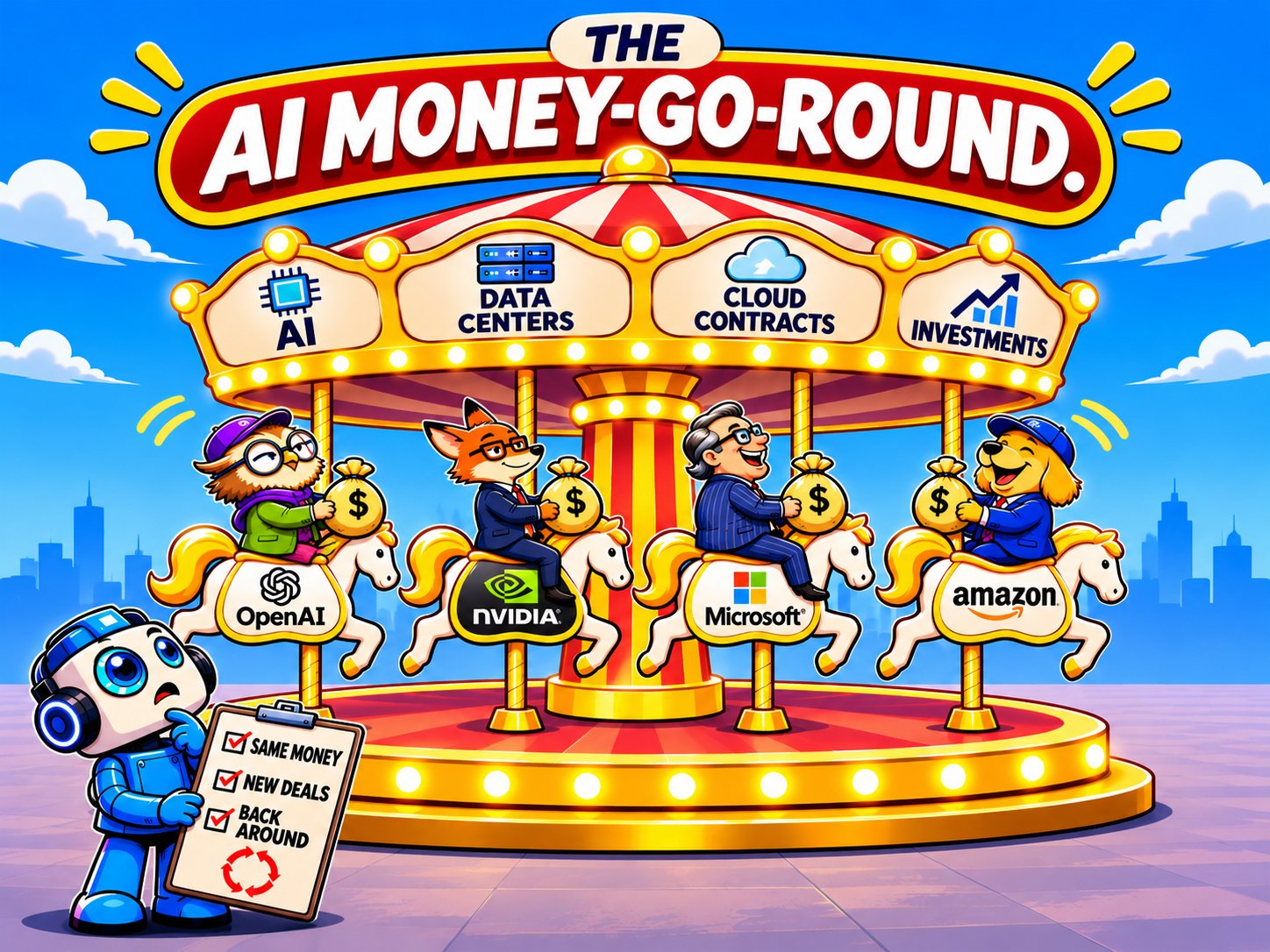
That's the circle. Congressional researchers put out a report on these arrangements this week. Suppliers invest in customers, customers buy equipment or computing power, and those deals help finance the next round of growth. Real products change hands. The question is how much of that activity can keep going once somebody has to fund it out of what actual customers pay.
Nvidia's investments and guarantees
The Wall Street Journal counted at least 293 investment and acquisition deals involving Nvidia since 2023. One arrangement in Ohio makes the stakes a little easier to see. Nvidia has offered financial guarantees connected to a data center campus where OpenAI is due to lease computing capacity that runs on Nvidia hardware. Under the conditions described in Nvidia's filing, those guarantees can total up to $105 billion.
A guarantee is a promise to step in if certain obligations aren't met. It can make it easier to get a building financed, because there's another company standing behind part of the deal. So Nvidia can help get the facility built, supply the technology going into it, and in certain circumstances be exposed if things go wrong. A chip company with a very busy financing department.
This is where I think the Jensen Huang story gets interesting. He resigned last week. This week California's attorney general subpoenaed Nvidia over reports concerning Huang and possible Chinese ties. The allegations deserve to be investigated. And I think there's a perfectly ordinary commercial reason Huang wanted access to China. He ran a chip company. China had customers who wanted to buy chips. The Trump administration had a say in which advanced chips those customers could buy, and I'd like to hear more about how it made those decisions.
The spy story is going to get the better trailer. The financing story is the one I'm watching to see what happens to the rest of the industry.
Debt means somebody has to pay interest
Anthropic's prospectus puts its purchase and lease commitments at roughly $901 billion. That includes years of spending and leases that haven't started yet. If you're Anthropic, getting hold of computing power early can be a very sensible decision. You need it to train new models and to run Claude every time one of us asks it to rewrite an email we've already spent 40 minutes rewriting. Amazon and Google both supply compute and have big stakes in Anthropic. Again, you can see why everybody would want to make that deal.
Now look at it from the side of the people providing the hardware. Reuters reported Friday that Apollo and Goldman Sachs arranged about $44 billion in debt financing for Nvidia hardware and related equipment for SpaceX. One slice, about $25 billion, came with a yield of 8.259%. Yield is roughly what investors expect to earn at the price they're paying, assuming they're paid as promised. To get a sense of the scale, 8% on $25 billion is about $2 billion a year in a simple illustration. The actual bond payments work differently. And every extra percentage point at that scale is another $250 million a year on the same simple math.
Stock investors can have a horrible Friday and the company doesn't suddenly have to mail them a check. With debt, somebody really does have to make the payments. And here's the odd bit about Friday. The yield on the 10-year US Treasury actually fell as investors moved toward safer assets. At the same time, investors buying that chunk of chip financing were getting more than 8%. When I say the bond market matters, I mean the price of funding the buildout, especially for the borrowers lenders are more nervous about.
A contract worth up to $120.5 billion, with a 90-day exit
SpaceX's AI business is also one of the places Anthropic buys computing power. The agreements are worth up to $120.5 billion through 2029. Once the initial protected periods end in January and March, either side can cancel the relevant agreement with 90 days' written notice.
I've had gym memberships that were harder to get out of.
Here's why it matters. If you're counting on that customer to fill your machines for the next few years, the value of the contract depends in part on whether the customer stays. If you're counting on those machines to run Claude, the same clause matters to you coming the other way. A very big number on the front of a contract tells you surprisingly little about how long the people involved have to stick around.
And before any of this computing power shows up, someone has to get a building connected to the grid. We talked about the data center backlash after the midterms. This week Reuters reported that developers are still looking for clarity on grid rules and facing the prospect of local restrictions. If your town thinks it's picking up the tab for somebody else's power bill, it has every right to ask who pays. For the developer, if you borrowed on the assumption you'd be earning money in June and the power turns up in December, you've got six more months to finance and six fewer months of income that year. It turns out the county planning office can do quite a lot with a calendar.
How far a correction could go
The mild version is that stock prices come down. A few projects get shelved. People still pay for tools they use, and demand grows at a pace that has some connection to what the tools earn. I'd welcome quite a lot of that.
Then there's the version where a developer can't make the numbers work. It delays orders, the chip supplier loses future sales, the investors take a hit, and the lenders get choosier about who else they'll finance. If several companies are relying on the same customers, guarantees and investors, that can spread. A tech sell-off becomes a credit problem when people start worrying whether they'll get paid back. How far that travels depends on who's exposed, how much they can absorb, and whether there's enough demand from paying customers to keep the equipment busy.
What it means if you run a creative company
For those of us who actually use this stuff, the practical question is what we rely on. If you're building a workflow for a show that's going to run three seasons, can you take your data and move it if a provider doubles its prices or drops the model you built around? You can think Claude is brilliant, as I often do, and still want an answer to that question before you build your production schedule around it.
I think the AI trade needed a correction. The technology is already doing useful things, and I want creative companies to get the benefit of that. What I'm watching now is who ultimately pays for all this computing power. If that's businesses paying for work they genuinely need, there's something to build on. If it's the same handful of companies passing the bill around, sooner or later somebody's going to ask for the check.
If you want to build on AI tools without tying your production to one provider's prices and plans, our AI strategy work and CTO as a service are built for creative companies. Book a free discovery call.
Sources
- Reuters: Anthropic prices blockbuster IPO
- Reuters (via Investing.com): Anthropic's blockbuster debut tests Wall Street's faith in AI boom
- Reuters: Nasdaq plunges 5% a day after Anthropic debut (markets and Treasury yields)
- Reuters: SEC's Nvidia probe is examining potential accounting issues
- Congressional Research Service: report on circular financing arrangements (IF13349)
- The Wall Street Journal: Nvidia is the central bank to AI's circular economy
- Nvidia: quarterly filing (Form 10-Q), including the Ohio guarantees
- Reuters: Nvidia CEO Jensen Huang to step down
- Reuters: California attorney general subpoenas Nvidia over concerns about former CEO and China
- Anthropic: prospectus (commitments, shareholder relationships and SpaceX.AI agreements)
- Reuters: Apollo and Goldman lead $44 billion SpaceX GPU debt financing
- Reuters: Data center builders seek clarity on rules for the largest US grid
This article is adapted from the November 23, 2026 Week in Review episode of Technically Creative.