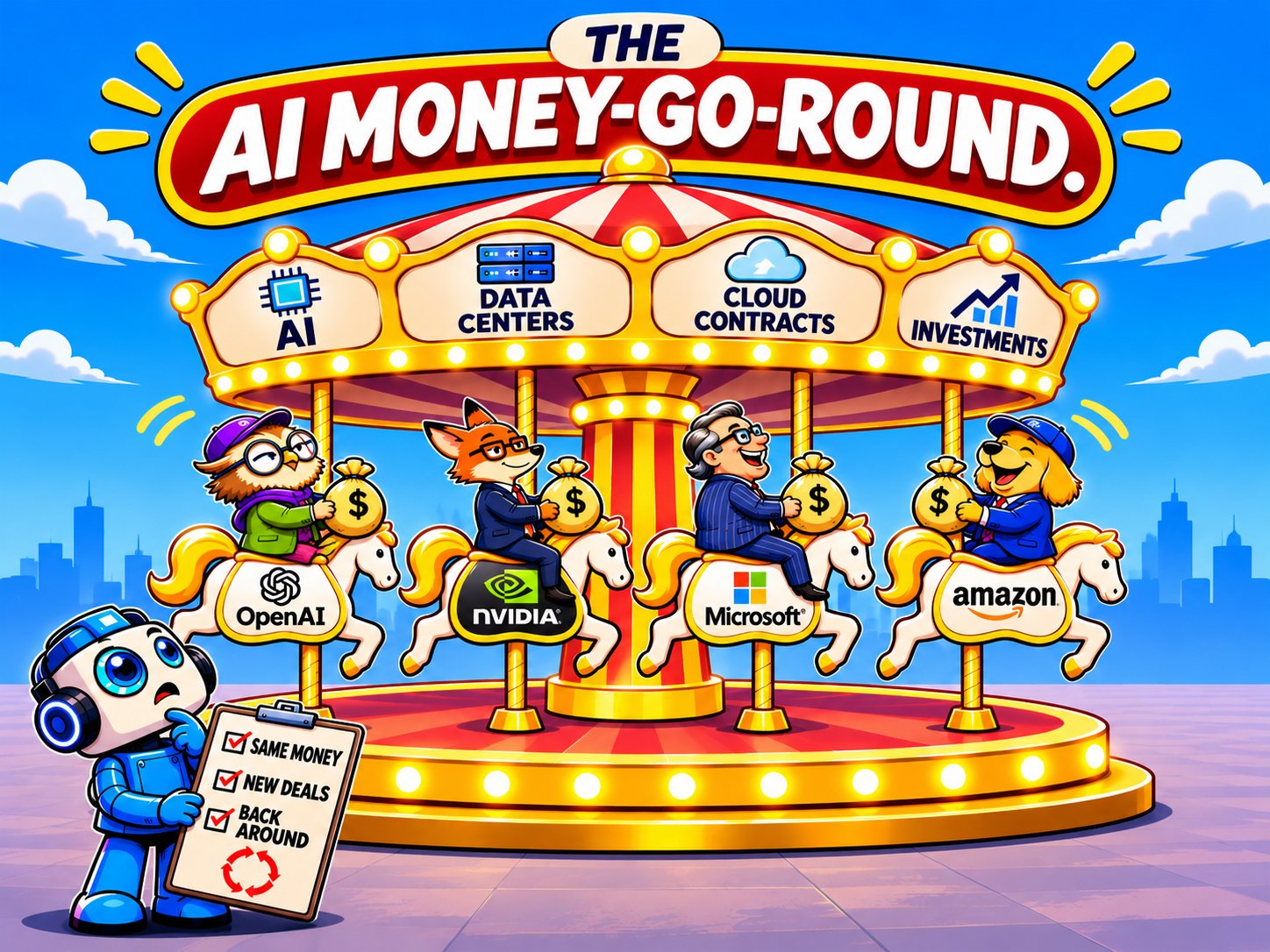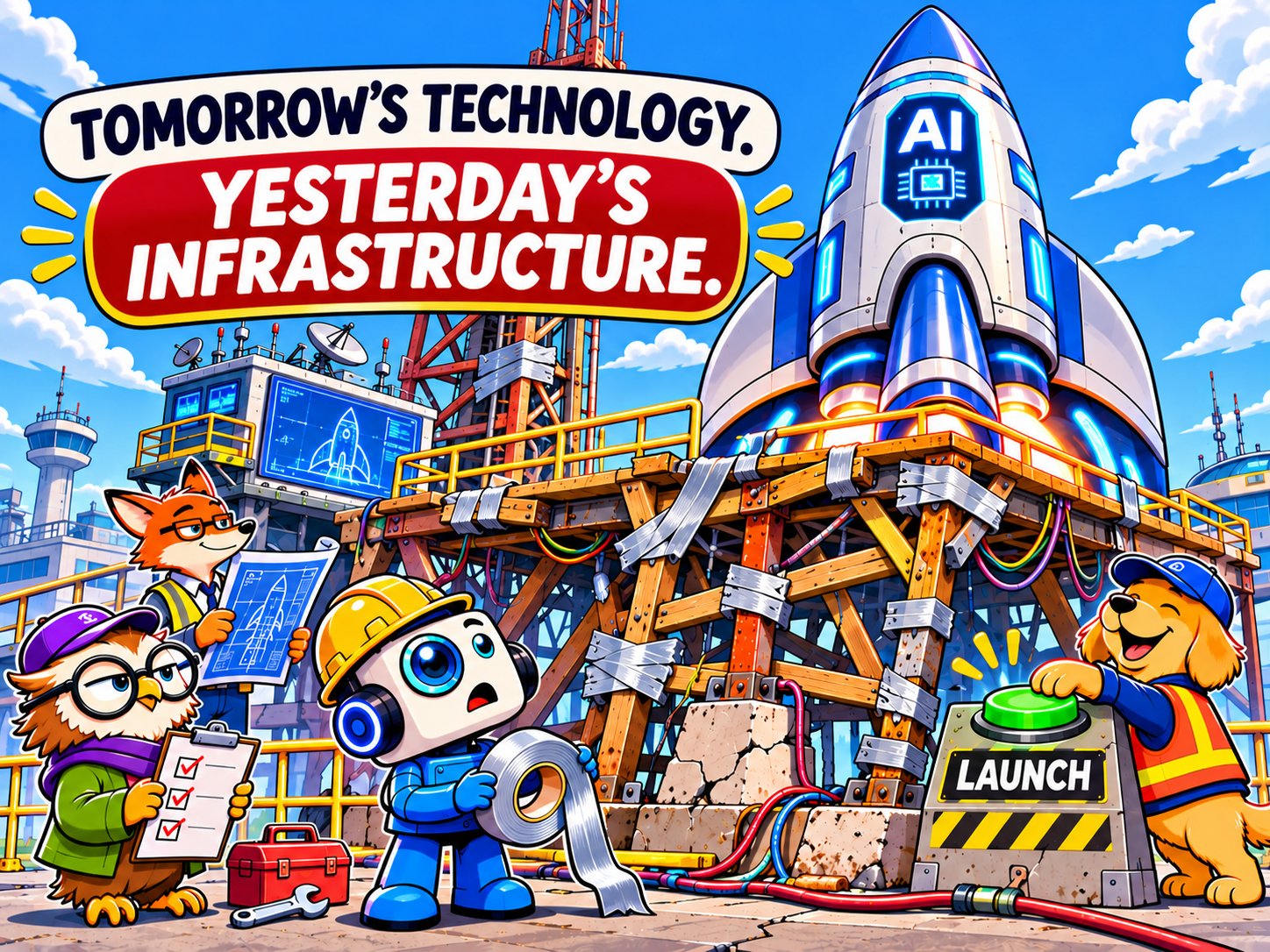
On Friday afternoon I was on one of the flights that didn't go anywhere. I was on that plane for 20 hours. Somewhere in those hours I started wondering about all the new technology we're rushing to use, and what it's actually running on. Are we putting tomorrow's technology on yesterday's infrastructure? Last week suggests we are.
The week the old layer broke
At 3:54 p.m. Eastern on Friday, November 13, the FAA grounded every departing flight in the United States after a communication problem hit its Air Route Traffic Control Centers. The stop lasted more than four hours, with about 3,500 planes in the air when it began. It was the first nationwide ground stop since January 2023, and only the second since 9/11. Transportation Secretary Sean Duffy blamed old, overloaded network equipment that started giving inconsistent readings, and said the stop was a precaution. There's no sign of a cyberattack, and the full cause is still being worked out.
Here's where the timing gets interesting. Three days earlier, on Tuesday, November 10, the FAA expanded SMART, its AI-assisted traffic planning system, to the airspace of all 22 of those centers. SMART pulls together about 200 data streams, including weather, flight paths, traffic flows and controller staffing, and recommends reroutes and schedule changes. There's no evidence SMART caused Friday's failure, and I'm not saying it did. But I think that's only one way of looking at the problem.
New technology needs bigger, faster data infrastructure underneath it. An AI system can work exactly as planned, with no agents going rogue, and still ask more of the systems below it than they were built to give.
It has happened before. SMART first went live around Washington on September 21. That same day, an equipment outage at the Philadelphia facility that handles Newark grounded flights across the Northeast, and the fix was repairing severed telecom lines. The FAA is pulling up copper and putting down fiber, but it's still the same basic data architecture we've had for 50 years. Twice now, the AI has turned up for its first week and the building has fallen down around it.
The day before the ground stop, Microsoft 365 went down. Outlook, Teams and Copilot stopped working for users around the world on Thursday, November 12, and it took into Friday to recover. Microsoft traced it to an issue from an earlier network capacity upgrade that surfaced after a recent network change, and went out of its way to say the outage was "not related to cyber or AI / agents."
Listen to the wording, though. A capacity upgrade. All these new tools need a lot more capacity. It's what we talked about last week with data centers. Our grid needs updating, and so do our data systems.
Every failure happened at the oldest layer
Line the week up and nothing broke at the AI layer. The traffic planning system did its job. The network equipment underneath it didn't. Microsoft's assistant didn't go rogue. Somebody changed a network setting after an upgrade. Every failure happened at the oldest, most ordinary layer of the system.
And the oldest, most ordinary layer of any system is us. People are the messiest, most fragile part of any technology. We reuse passwords. We click the link. We take the work laptop home. We trust the nice person on the phone. We post our runs. An engineer can rip out a 50-year-old router and put in a new one. Nobody has found a way to patch a human being. The more sophisticated the machinery gets, the more the weak points move to the person standing next to it.
Your morning run is intelligence
This weekend the Los Angeles Times showed what that looks like at its most serious. It reported on how Iran picked its targets when it struck American bases in the Middle East. It didn't hack military systems. According to the security experts and US military personnel the paper spoke to, Iran used service members' social media, fitness apps and even ad data to work out patterns of life on the bases: who goes where, and when. That's commercial data. Iran paired it with satellite imagery believed to have come from Russia, and built a remarkably accurate picture. In August, a Sky News investigation found more than 1,300 users logging workouts on the fitness app Strava at US bases in the region.
People died in those attacks. This isn't a joke. If there's a joke, it's the decade we spent as individuals saying "I've got nothing to hide, who cares what they know about me?" It turns out even your morning run can matter.
One laptop, $6.3 billion
Same pattern, different target. On October 29, the crypto exchange Binance lost an estimated $6.3 billion, with about $3 billion since frozen. Its first finding was that the breach may have started with one compromised laptop belonging to a DevOps engineer. Its fuller account in early November described a months-long campaign that included a fake job interview and three compromised engineers. Either way, the way in was people.
AI makes finding the weak spot cheap
So we have old infrastructure and fallible people. Now add AI that can look at everything at once. Everybody knows a chief executive is a target. The person logging workouts on a base isn't sure how important they are. AI can assess every weakness in a system at the same time.
Science fiction always told us the machine would turn on us. What's actually happening is a lot smaller. The machine is getting very good at reading us. Finding the person with the key used to be slow, expensive human work: going through LinkedIn, mapping who works where, who has which login, who posts their gym sessions, who's just started a new job and might fall for a fake interview. That's exactly the patient, tedious research AI agents are brilliant at. So AI is finding our weak spots and working out what's valuable about us at the same time: what we know, what we can open, who we sit next to. That work is about to get dramatically cheaper.
In the AI era, you don't have to be an important person to hold important information. You just have to not know how important the information you touch is. A running app becomes military intelligence. One engineer's laptop becomes a $6 billion back door. An email outage stops work around the world. There isn't a separate tech part of life anymore, off to one side where the nerds worry about it. It's all one system, and we're all part of it.
That means updating more than the physical systems. We have to update our own relationship to our data, and put it behind stronger walls.
Creative companies are targets too
For a long time, creative people and creative companies have felt like the least important part of that system. Creative people tend to think the targets are defense contractors and crypto exchanges. Who on earth wants our stuff? It's a pitch deck. It's a rough cut. It's a song that isn't finished.
Governments have understood for a very long time that stories are power. In 2014, the US government said North Korea was behind the attack on Sony Pictures over The Interview, a comedy about killing Kim Jong-un. Unreleased scripts, executive emails and people's salaries all ended up online. A nation state attacked a film studio over a Seth Rogen movie.
I'd go one step further. I think one of the reasons the West has led the world for the last century is its creativity: the films, the music, the advertising, the television, the stories that traveled everywhere and made people want what we had and believe what we believed. You can call it soft power or you can call it propaganda. Honestly, it's been both. Every serious country knows it. That's why so many of them are pouring money into their own film industries, their own streaming platforms and their own pop stars.
So what we make isn't just commercially valuable. It's strategically valuable, and so are the people who make it. Your unreleased script lives on someone's laptop. Your rushes sit in a storage account that an assistant editor logs into from home. Your agency's client data lives in a Microsoft account that, as we learned on Thursday, isn't always there. If you're working on Nike's summer campaign for next year, you know Nike's marketing plan before anyone else does. That would be valuable to a lot of people.
Studios are now building private AI models trained on everything they own. Disney named Adobe its official AI innovation partner last week, to build models on Disney's own characters, environments and visual styles. A model like that is a wonderful tool. It may also be one of the most valuable creative files ever assembled in one place. Someone, somewhere, is going to want it.
You don't have to be a defense contractor to be a target. You just have to work near something valuable. In this business, a lot of people do.
What creative companies should do
I'm not a doomer about any of this. These tools will make enormous things possible, and small creative companies will be able to do things only giant ones used to. But if the human layer is the weak point, that's where the work starts.
- Assume people want your work, because they do. They might not even know why yet. They'll figure it out once they see it.
- Assume the fake interview, the fake supplier and the fake producer on the phone are coming, and that they'll be convincing.
- Give AI agents the smallest set of permissions they need to do their jobs, and make sure a named person knows exactly what each one can and can't touch.
Last week Microsoft lost our email and America lost the ability to get planes off the ground. None of it was caused by an AI agent, or so they say. That kind of proves my point. The machines aren't the weak spot. We are. And the machines are getting very, very good at finding those weak spots.
If you want to find the old systems and human weak points in your company before someone else does, our IT managed service and security sprint are built for creative companies. Book a free discovery call.
Sources
- ABC News: Nationwide ground stop lifted after more than 4 hours as Trump administration blames old, overloaded tech
- NBC Chicago: FAA lifts nationwide ground stop issued due to "extraordinary circumstances"
- Wikipedia: 2023 FAA system outage (first nationwide ground stop since 2001)
- AeroTime: FAA expands AI traffic planning tool to all 22 US en route centers
- SupplyChainBrain: FAA grounds flights at seven airports after equipment outage (September 21)
- AeroXplorer: FAA equipment outage grounds flights at Newark, JFK and Philadelphia airports
- ABC7: Microsoft apologizes for email disruption, says there was no hack
- Deadline: Microsoft "deeply sorry" about global Outlook outage, cites capacity upgrade
- Los Angeles Times (via Lewiston Tribune): How Iran parlayed evidence from social media, fitness apps and satellites into info about U.S. bases
- Task & Purpose: US bases, troops are once again being exposed by Strava (reporting the Sky News investigation)
- BleepingComputer: Binance links $6.3 billion crypto theft to compromised DevOps laptop
- Crypto Briefing: About $3 billion in affected assets frozen
- BIT: Binance's fuller account of the breach
- FBI: Update on Sony investigation (2014)
- Adobe: Adobe and The Walt Disney Company announce multi-year strategic alliance
This article is adapted from the November 16, 2026 Week in Review episode of Technically Creative.