The biggest technology story of last week didn't look like a technology story. It looked like a political one. On Tuesday, Democrats took control of both houses of Congress and picked up a handful of governorships. You'll hear that explained as a cost of living story, a story about billionaires, and, more surprisingly, a story about data centers. Most coverage treats those as three separate stories. I think they're one story, and it's one big technology story.
What the vote was about
In the final Reuters poll before the vote, nearly half of registered voters called the cost of living their top issue, and about half of Americans said their finances had got worse since January last year. In the same poll, 93% of Democrats and 71% of Republicans said it's inappropriate for billionaires to spend tens of millions of dollars to sway elections.
Then there were the data centers. The AP went through the results. Of the 34 winning candidates for governor in races it had called, 32 support stronger regulation or restrictions on data centers, and 12 support bans or moratoriums. Referendums on data center restrictions passed in 44 of the 45 votes where counting had finished. About three quarters of voters said they'd oppose a new data center in their community. And it crossed party lines: one of the people who started a protest group in Lubbock, Texas, is a Republican, and she said the data centers were on the ballot.
The money, the buildings and the politics are one loop
Start with the money. Tech didn't cause your grocery bill to go up, but it is where the new fortunes are being made. Fifteen of the 34 newcomers to this year's Forbes 400 made their money in tech, and they account for nearly 60% of the newcomers' combined wealth. Forbes counted 45 new AI billionaires in the year to March alone. A lot of that wealth is on paper, shares valued on what investors expect companies to earn one day. That's the K-shaped economy in one sentence. If you own assets, the AI boom has been one of the best years of your life. If you're paying rent and buying groceries on a salary, you mostly get the price rises.
Then the buildings. The same boom that's minting those fortunes needs somewhere to physically happen, and that somewhere is a very large, very loud warehouse that drinks water, eats electricity and needs a new substation. The wealth goes national. The costs stay local. Texas elected its first Democratic agriculture commissioner since 1986, Clayton Tucker, who said fighting data centers was critical to his win because his ranchers were worried about water.
Then the politics. In the Texas Senate race, Ken Paxton wanted to make Texas the center of America's AI industry through rapid data center construction, and James Talarico campaigned for tighter rules. Elon Musk spent nearly half a billion dollars backing Republicans this cycle, including $158 million through a super PAC supporting Paxton in September alone. Talarico won. To put the scale in perspective, $445 million is the same share of Musk's net worth as $445 is to someone worth a million dollars. A political campaign for the richest man on earth costs about what a nice dinner costs a millionaire.
Put it together: technology is creating the new fortunes, needs the new buildings and is funding the new political spending, while most voters feel poorer. That isn't three stories. It's one loop.
Where the anger goes wrong
On Friday, protesters broke into a Microsoft data center construction site in Amsterdam, climbed a crane and set off flares, part of a campaign planned across 15 European countries. One told reporters the only thing it would be used for was AI slop. It isn't, though. Data centers run your email, your cloud storage, your streaming, your render farm, your hospital records and, yes, your AI tools.
Even the AI part isn't all chatbots making pictures of the Pope in a puffer jacket. If AI means everyone now answers all of their emails instead of a tenth of them, that's an enormous amount of extra data that has to be stored somewhere. You could call a lot of it slop, but it's slop you need. The day you go looking for an email exchange and it isn't there, you'll be furious. And the rest of the world isn't pausing. China is building data centers across its cheap-energy rural provinces at astonishing speed, with a plan worth about $300 billion over five years.
So when some politicians called for a national data center moratorium the day after the election, I think that's the wrong answer. Stopping building doesn't make the demand go away. It moves the computing somewhere else, probably overseas.
The middle ground nobody is fighting for
"We need data centers" and "we need this data center, here, on these terms, with your grid paying for it" are different arguments. The industry has been getting away with treating them as one binary choice. There are better ways to do this. Amazon and Veolia are building a system in Mississippi that will cool a data center with treated municipal wastewater, reusing more than 80 million gallons a year instead of pulling it from the local supply. You can build away from where people live. You can pay for your own power. Almost nobody seems to be fighting for that middle ground. It's either build anywhere or build nothing.
This week, for the first time, somebody flinched. Two days after the election, OpenAI published what it calls a community compact. It says OpenAI will cover the energy costs of the infrastructure it builds rather than passing them on to the public, warn communities about the impacts, publish reports on the jobs it expects to create, and stop using non-disclosure agreements with public officials. Which tells you it was using non-disclosure agreements with public officials. It also calls the sites "compute campuses" now: two days after data centers lost an election, they got rebranded as universities. These are promises, and they need checking. But paying your own electricity bill and telling the neighbors what you're building is a far better place to start than either extreme.
Why creative companies should care
If you make films, ads, music or books, this is your problem too. If these buildings get harder to build, creative businesses will feel it in what they pay for rendering, storage and AI tools well before most people notice. The question was never whether this technology can create enormous wealth. It plainly can. The question is whether the people who live next to the machines see any of it. On Tuesday, a lot of them answered.
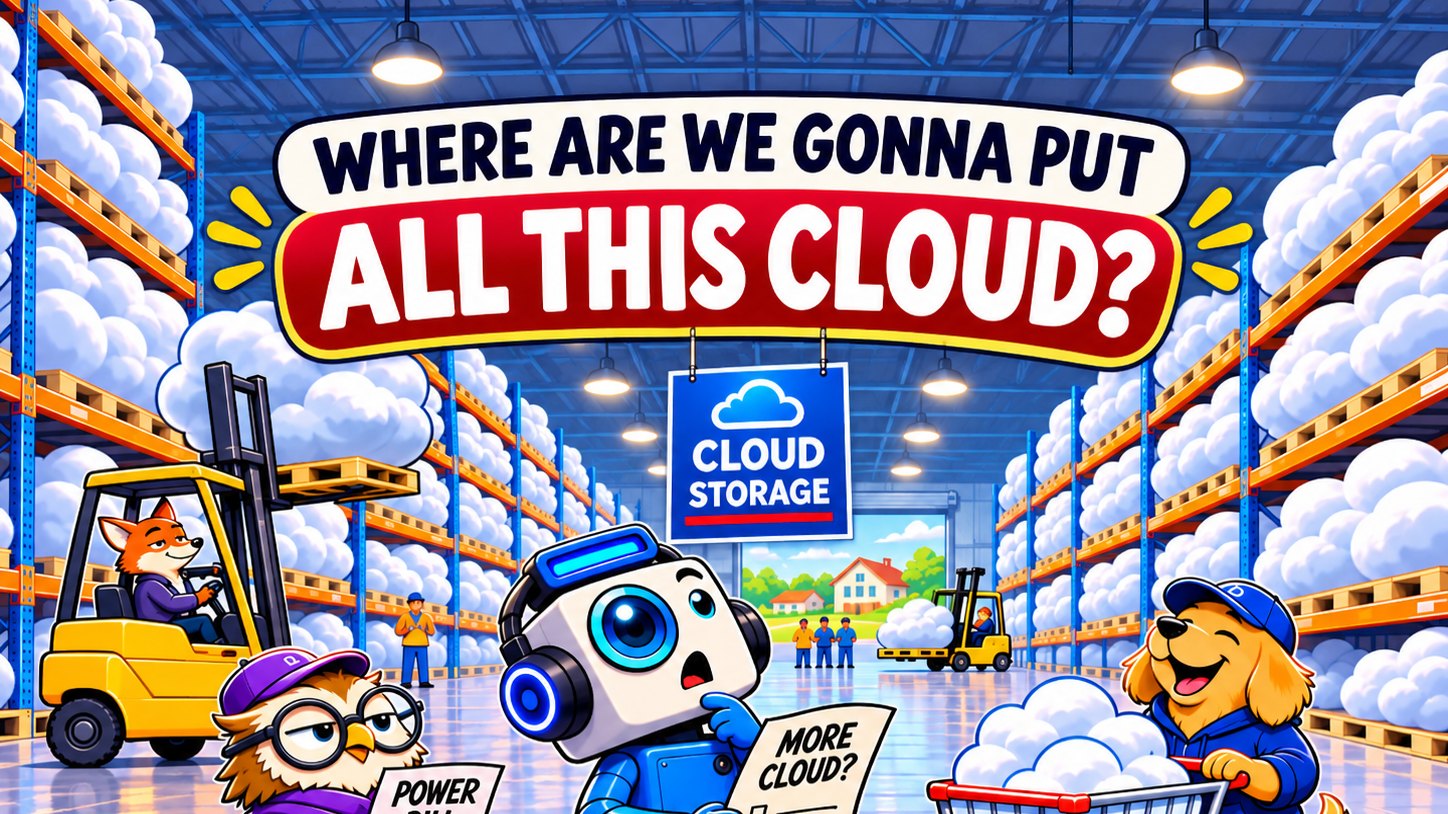
The cloud has to live somewhere. It turns out that somewhere has a vote.
If you want a clear picture of what your rendering, storage and AI tools really cost and where they run, our IT managed service and AI strategy work helps creative companies plan for it. Book a free discovery call.
This article is adapted from the November 9, 2026 Week in Review episode of Technically Creative.