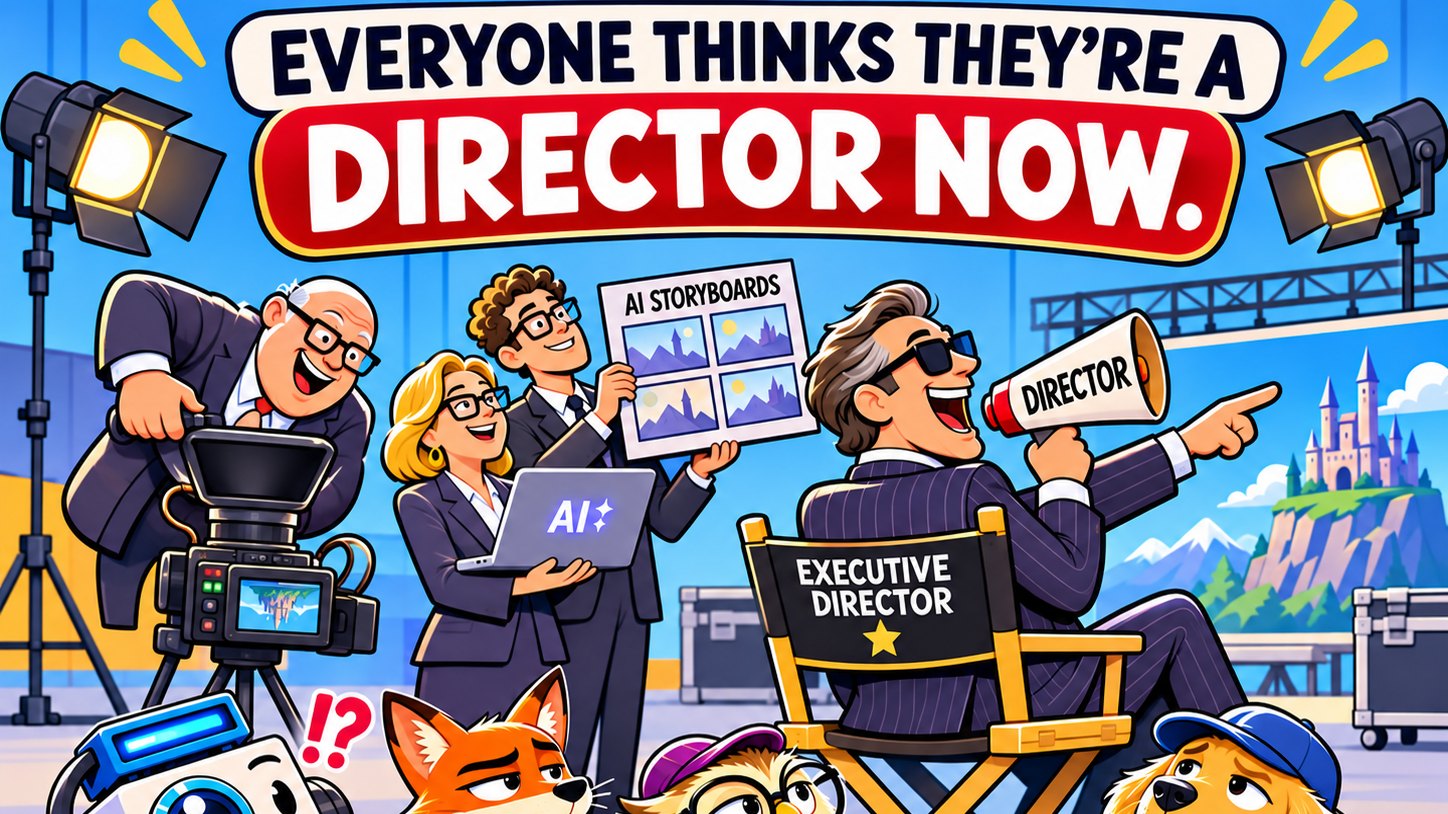
Most people covered this as a plagiarism story. I think it is much bigger than that. It is a story about people who could never touch your finished work before suddenly being able to change it, because of AI. Everybody seems to think they are a director now. That is inspiring when it is a kid with a laptop. It is a problem when it is the person who commissioned your film.
What happened
ASAP Rocky released a song with a music video on October 16. About a week later, the VFX artist Cash Bunny posted a side-by-side comparison with a sequence they had made in 2019, except the person in the middle had been swapped for ASAP Rocky. The claim is that their footage was taken, run through AI and given a new lead.
ASAP Rocky's creative director posted on Instagram and, to his credit, didn't dodge it. He said a breakdown in the review process for generative AI assets led to the unattributed use of Cash Bunny's work, and that he takes accountability. Good for him. So far, an AI plagiarism story.
Then the production company spoke up. The video was made by Prodco with its director, and Prodco says it delivered the finished director's cut to the client in January 2024. The song came out this month, so the client sat on a finished film for almost three years. Prodco says the version it delivered had none of the AI shots or the disputed imagery, that all of it was added later without its knowledge or the director's consent, and it has taken its name off the credits. This week the director and Prodco released their own cut and said that was the end of their involvement.
We don't know who made the changes. ASAP Rocky is credited as co-director, but nobody has said he did it himself, and I'm not saying that either. What we do know is that somebody on the client side took a finished film, made new material for it, cut it in and released it, and nobody picked up the phone to tell the people who made it.
What everyone is missing
Think about it from the production company's side. You pitched it, cast it, shot it and cut it, and put your own money and people on the line. Most people don't realize how little money music videos have; production companies often put their own money in as a showcase for directors they believe in. You delivered and moved on, waiting for the release so your director could have a moment in the sun. Three years later it comes out with shots you've never seen, without your name, and it's in the news because one of the shots you didn't make was taken from somebody else.
The client always owned the footage. Labels have recut music videos forever, and agencies recut commercials constantly. I have been on the wrong end of that more times than I'd like to remember. Nothing about who owns the footage has changed. What has changed is what the client can do with it.
Before, if a label wanted new shots in a finished video, it could pay the original team to make them, or secretly hire a different company to shoot more behind their back. Almost nobody did the second, partly because it was expensive and mostly because it was an extraordinary insult. Word gets around, and no decent director would work with you again.
I increasingly feel we told ourselves a nice story about the respect commissioners showed their production partners. Some of it was real. A lot of it, it turns out, was a capability gap. They respected you because they needed you. Now someone with a laptop and a subscription can generate a new shot, drop it into your cut, and nobody has to find out until it turns out the shot belonged to somebody else.
Writers got this in writing. Directors didn't.
This is exactly what writers feared when the WGA went on strike in 2023: a studio executive putting a script into ChatGPT and asking it to punch up the second act. And they won. Under the 2023 contract, a studio can't use AI to write or rewrite a writer's literary material. That matters not just because it is rude, though it is, but because revisions are paid work. A studio rewriting with a chatbot is taking money out of a writer's pocket.
It is the same here. New shots would have been a paid job for the production company and the director. Instead, the people who made the film got neither the job, nor a phone call, nor the credit. Writers got their protection in writing. Music video directors and commercial production companies have nothing like it.
The disrespect and the provenance failure are the same failure
Cutting out the production company is also, weirdly, why this went wrong in the first place. The director and producer are the people with a professional stake in what is in that footage: their name, their reputation, their reel and their money. They are the quality control, and they weren't in the room. So nobody with skin in the game looked at that AI shot and asked: hold on, who shot this, and where did it come from?
The creative director called it a breakdown in the review process. The review process should have been the production company, and it was cut out of the whole system.
World models make it easier still
This will happen more. The same week, Google DeepMind released Genie 4 as a research preview. It isn't a video generator that makes a shot. It is a world model that makes a place: give it a prompt and it builds a photorealistic environment you can move through in real time, changing the weather, moving the camera or adding a person as it runs. It is early, and a scene only stays consistent for about two minutes, which makes for a very expensive establishing shot.
But that is where this is going. Today a client can generate a shot here and there and hope it cuts in. With world models, they can rebuild your location, your camera position and your light. There used to be a ritual at the end of a shoot: the set gets struck, the lights go back on the truck, and anyone who wants more of that world has to come back to the people who built it. Nobody needed to write that deal down. The physics of the world wrote it for us. The set doesn't have to be struck anymore.
Put it in the contract
So what do you do if you run a production company, direct, or run a VFX house? The answer isn't clever: put it in the contract. If a client wants to alter the work after delivery, you get notice before it goes out, and approval over your credit. That protects your name and your work. And you get first refusal on any new material at a rate, because that is a job and it always was.
The courtesy the production community used to get was never written down. It never had to be, because clients couldn't do it without you. That guarantee is gone. If you can't count on a client's manners anymore, put it in the paperwork.
This isn't only about manners. It is in the client's interest too. The label paid for a director's eye and a producer's paranoia, and threw both away at exactly the moment it needed them most. If anyone on the client side had sent the production company one email saying "we're adding a few shots, can you take a look?", there's a decent chance Cash Bunny's work never ends up in that video. Nobody posts an apology on Instagram, and nobody writes this article. That email would have been cheaper than the AI.
Whichever side of the commission you're on, the old rule still holds: call your collaborators and tell them what you're doing. Being able to generate something doesn't mean you can skip the people who made the work. Production companies invest in these videos. When your father-in-law pays for half the wedding, you listen to what he thinks of your choices.
If you're writing generative AI into your production contracts, approval process or AI policy, our AI strategy and transformation work helps creative companies set those rules before something goes wrong. Book a free discovery call.
This article is adapted from the November 2, 2026 Week in Review episode of Technically Creative.