Ten days before this episode, the stock market hit an all-time high. Then a chatbot company with 12 million users went bankrupt, Netflix made billions and still cut around a thousand jobs, Anthropic told investors it is profitable, sort of, and Hollywood’s three biggest agencies asked Congress to make the streamers buy half their shows from somebody else. So everything’s fine, right?
Is everything fine?
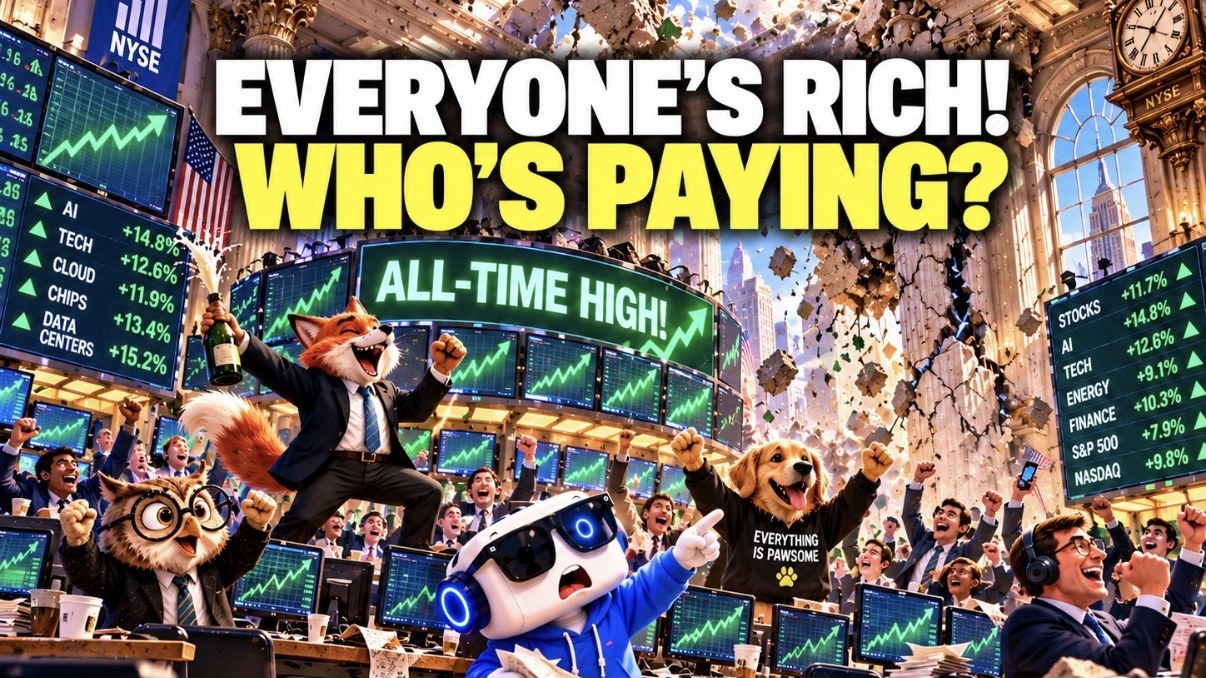
On Tuesday, October 6, the S&P 500 closed at a record high. Wall Street's explanation was, more or less, AI: a bet that the hundreds of billions going into data centers will pay off. This week the S&P had its worst week since June and the Nasdaq fell four and a half percent. Inflation came in hot, oil went over $100 a barrel and traders now expect rates to rise in December. That last part matters, because a lot of the AI boom is paid for with borrowed money.
The circular money
CoreWeave is basically a landlord for AI. It buys huge numbers of Nvidia chips, puts them in data centers and rents the computing power to companies like OpenAI and Meta. According to Reuters it carries about $50 billion of debt and has never made a profit, and this week its bonds traded at yields around 15 percent. Its CEO says more than $100 billion of contracted business will cover the debt, and he may be right. I run a company that buys AI compute, and the demand is very real.
But look twice at this: Nvidia sells CoreWeave its chips, Nvidia is an investor in CoreWeave, and Nvidia has agreed to buy any CoreWeave capacity nobody else buys through 2032. Supplier, shareholder and customer of last resort. None of that is illegal, but it raises a fair question about how much of the demand comes from the people selling the chips. The pattern repeats. Data center company Fermi pulled a $5 billion IPO when investors didn't show up; Nvidia is an investor there too. Amazon booked a $53 billion gain last quarter, mostly from its Anthropic stake, and Anthropic has committed more than $500 billion to cloud and compute over the next decade, much of it with companies that own pieces of it.
Imagine a landlord who invests in his tenant's startup so the tenant can afford the rent, then counts the startup's rising value as profit. Everyone's balance sheet looks great, right up until somebody calls in a debt.
Anthropic's investor day
Full disclosure: KoobrikLabs is an Anthropic partner, and I am an Anthropic investor. On Wednesday Anthropic held an investor day ahead of its planned IPO. According to the Financial Times, Reuters and Bloomberg, it made $16.8 billion in revenue last quarter, nearly four times its revenue for all of 2025, and said it was profitable on an adjusted basis and cash flow positive. In an industry whose model has mostly been lose money now and explain later, that is genuinely good news.
But Anthropic didn't give a dollar figure for that profit. Reuters reported an adjusted operating margin of about 11 percent, which by my arithmetic, not theirs, is roughly $1.8 billion, and nobody said what "adjusted" leaves out. Growth is also slowing: revenue more than doubled the quarter before, and grew 45 percent this quarter. Reuters said some investors now talk about a $1.5 trillion valuation rather than $2 trillion. We will know more within weeks.
Character.AI runs out of road
Character.AI filed for bankruptcy on Monday. Around 12 million people were spending hours with its AI characters, more people than live in Belgium. According to Reuters it was losing $8 to $9 million a month while fighting lawsuits and regulators over child safety. Then Disney arrived with a $20 million opening bid for the technology, a year after sending the company a cease and desist and shortly after hiring its former CEO as Disney's first CTO. That isn't a U-turn. It is the Disney model: embrace new technology, on Disney's terms, inside Disney's walls. Character.AI had huge engagement and still couldn't escape the economics. Storytelling raises money, but eventually revenue has to beat overhead.
Netflix: healthy and cutting
This is the story that worries me most. Netflix is laying off about 6 percent of its staff, roughly a thousand people in product, technology, legal and HR. It made $3.4 billion in profit last quarter, up 9 percent. There is no evidence these cuts were caused by AI, and Netflix hasn't said so. But AI doesn't need to be the direct cause for this to matter. A public company is rewarded for value to shareholders, not for employment, and AI makes it ever easier for a successful company to ask whether it can make the same things with fewer people. For any one company, saying yes is rational. Multiply that across the economy and you get a question capitalism hasn't had to answer: what happens when the companies making the most money need the fewest people to make it?
So who's paying?
The AI boom rests on the assumption that a very large pile of revenue eventually turns up, mostly from companies paying for AI because it lets them do more with less. Either the money doesn't arrive, and we have a debt problem with CoreWeave's bonds as the canary, or it does arrive and a lot of it shows up as companies needing fewer of us. And Netflix makes its money from subscribers, who are people with jobs. Henry Ford supposedly paid his workers enough to buy the cars they built. The risk with AI is the opposite: an incredibly efficient factory and nobody left with the money to buy what comes out of it.
The agencies push back
Which is why one of the most interesting announcements came from the agents, not a tech company. CAA, WME and UTA, who agree on almost nothing, formed the American Entertainment Alliance with Jason Blum, Ron Howard, Brian Grazer and Peter Chernin. According to The New York Times, they want a bipartisan law requiring Netflix, Disney, Amazon and Skydance to spend half their original content budgets in the US on independent producers. France, Germany and the UK already have rules like this to protect their production communities from the big American streamers. Now the American production community is asking for the same.
It isn't new. In the 1970s and 80s the fin-syn rules limited how much the networks could own of what they aired, and a lot of great TV of that era came from independents. Since those rules went in the 1990s, the buyers have increasingly become the makers. The agencies won't hate the bigger paydays, but the idea underneath is right: an industry should create more companies, more buyers and more people getting paid, not just four buyers getting as efficient as possible. It was the only serious argument about the economics of the industry anyone made all week.
The market hit a record ten days ago. I'm not sure things are all good. If you're working out where AI genuinely saves your company money, and where it just moves the cost, our AI strategy and transformation work starts with exactly that question. Book a free discovery call.
The interview that followed this episode was with animator and director Hisko Hulsing: Booed for Using AI.
This article is adapted from the October 19, 2026 Week in Review episode of Technically Creative.