Case study
SuperBloom House: over $250,000 a year back from cloud storage
We built DataPulse, a tool that puts a monthly cost on every folder of a company’s cloud storage. With it, SuperBloom House passes storage costs through to the clients who create them and saves over $250,000 a year on its cloud spend. A modernization plan with AWS saved another $3,500 a month.
About the client
SuperBloom House is an independent media and production company with offices in Los Angeles and New York. It makes brand campaigns, films and content, and it keeps its working media in the cloud. We already run SuperBloom’s IT: see SuperBloom House: scalable creative IT infrastructure.
The challenge
SuperBloom’s media lives on two LucidLink filespaces and in Amazon S3. All of it is hot storage, charged every month for every terabyte, and it grows with every job.
SuperBloom could see what it paid each month, but not which clients and jobs the storage belonged to. Without that, storage was an overhead SuperBloom carried itself instead of a cost it could pass on to the clients creating it.
What we built
DataPulse, a Mac app that measures storage and puts a monthly cost on every folder. It scans local disks, NAS and SMB shares, cloud drives such as LucidLink, and Amazon S3, then opens a report in the browser.
- Cost per folder. Each source is priced at the rate SuperBloom actually pays for it, so every folder has a monthly cost, not just a size.
- Drill down. A treemap, bars and a full table. Click any block to open a source, then a client folder, then a job.
- Change over time. Every scan is kept, so the report shows what grew, what shrank and what disappeared since the last one.
- Problems in plain words. If something can’t be read, the report says what, where, and what it means for the totals.
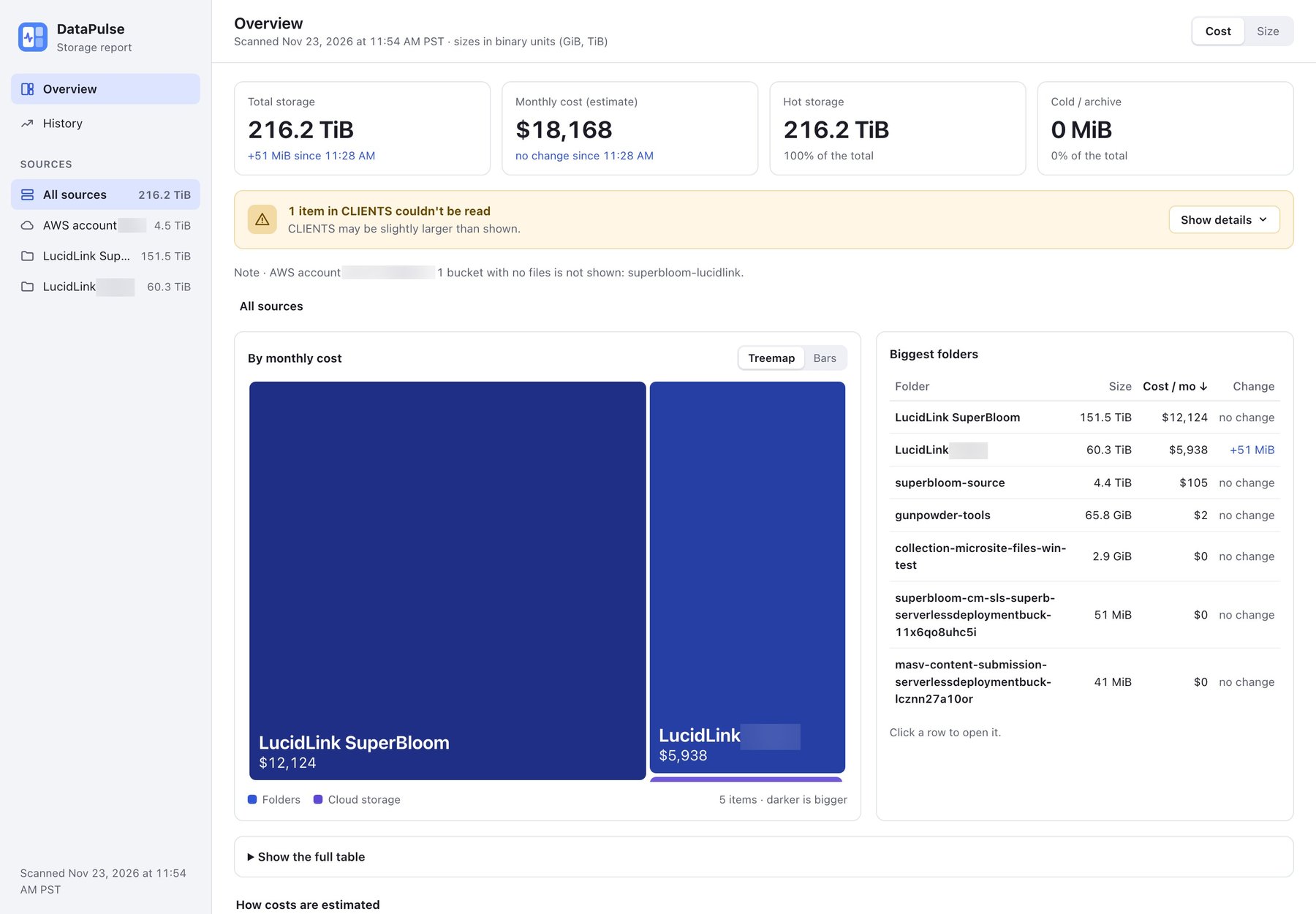
The DataPulse report. Client names and account details are blurred.
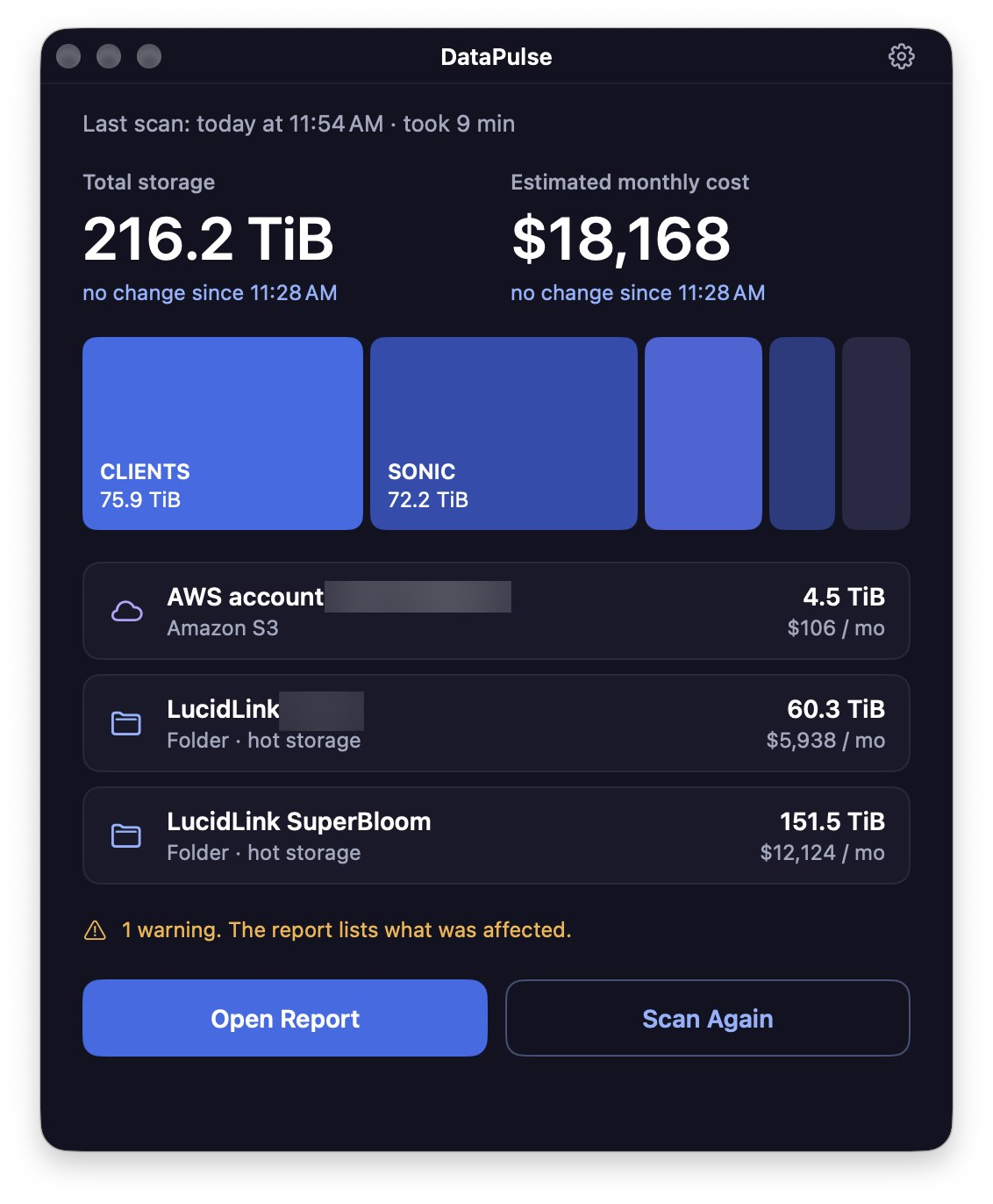
The app after a scan: totals, the biggest folders and each source.
Passing storage costs to clients
SuperBloom’s client work sits in client folders, so every scan gives a monthly storage cost per client. SuperBloom uses those numbers to recharge storage to the clients who use it, and to cut storage it no longer needs. Together that saves SuperBloom over $250,000 a year on its cloud spend.
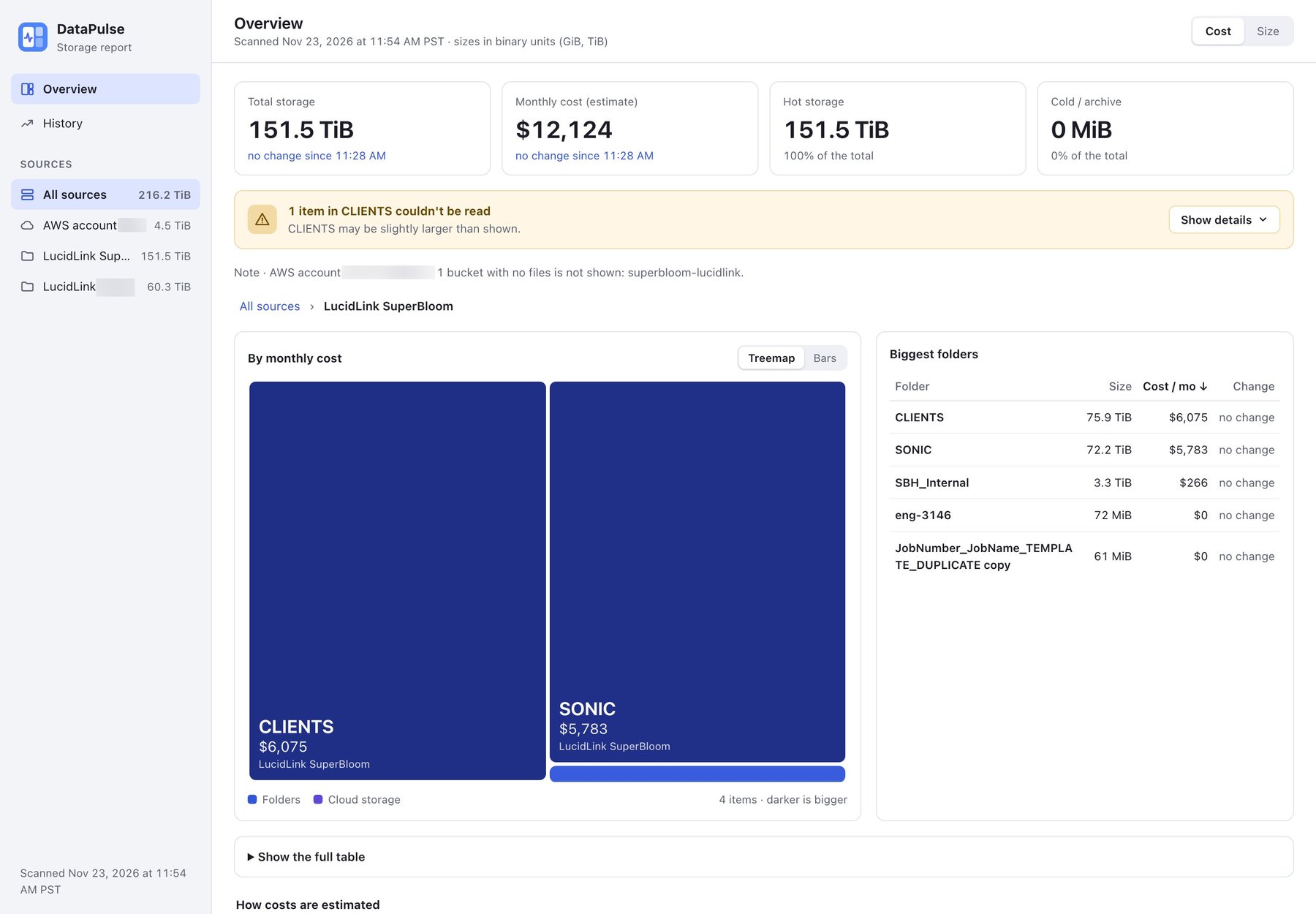
One filespace opened by top-level folder, with the monthly cost of each.
A modernization plan with AWS
We then worked with AWS on a modernization plan for SuperBloom’s AWS environment. It saved another $3,500 a month.
Read only, by design
- It never touches the media. DataPulse only reads. It never changes, moves or deletes a file.
- No passwords. Amazon sign-in happens on Amazon’s own page. DataPulse never sees a password and keeps no permanent keys.
- Built for very large filespaces. Progress keeps moving even inside a single folder of tens of terabytes. A full scan of all 216 TiB took 9 minutes.
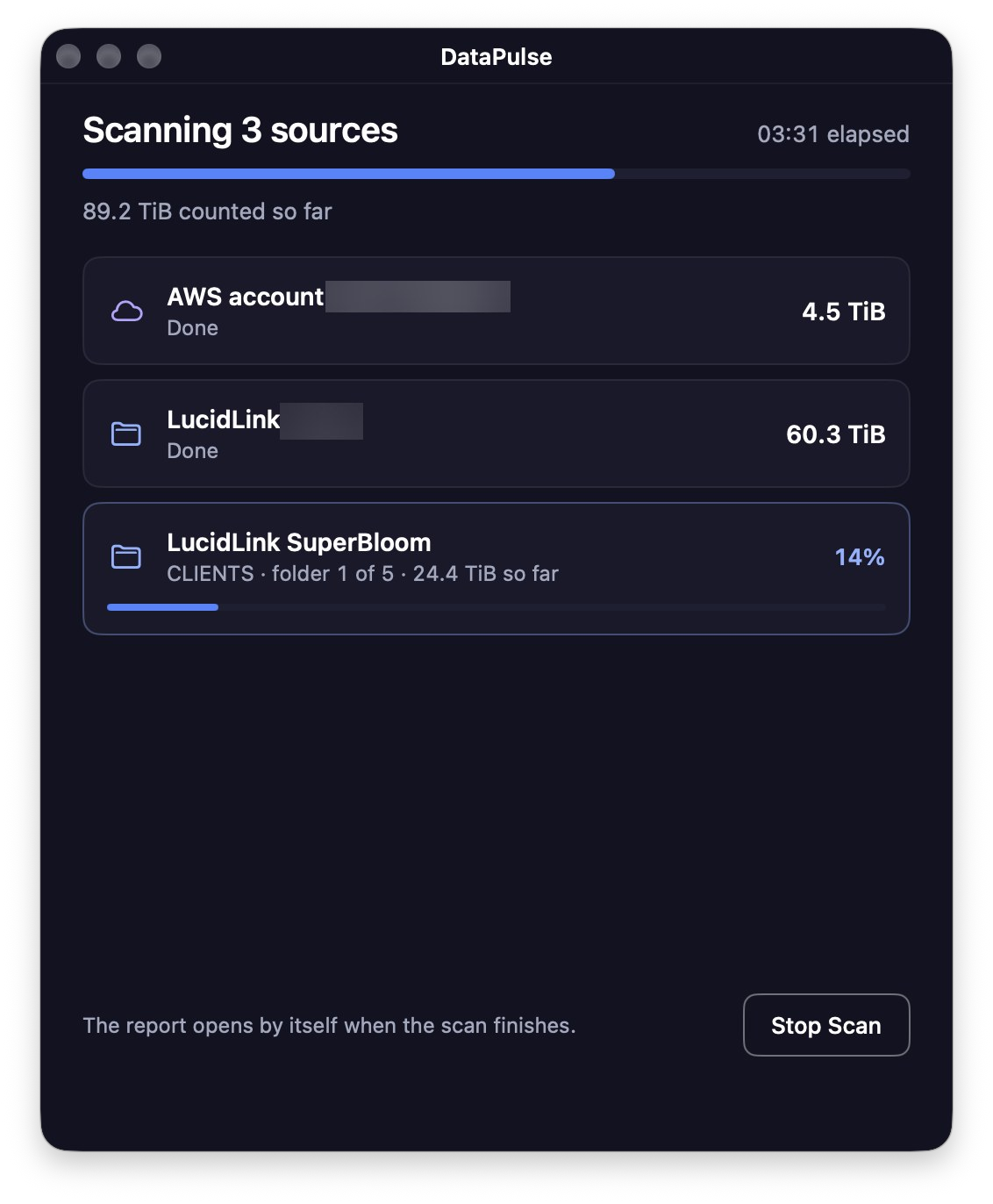
Scanning three sources, folder by folder.
Built by someone who has run media storage
DataPulse was built by Nathaniel Chadwick, head of IT at KoobrikLabs. Before joining us, Nathaniel was head of asset management at Trailer Park and AV Squad, two of Hollywood’s leading entertainment marketing companies, where he built and ran the media workflows for some of the most sensitive assets in the industry. Before that, he led technical operations for asset management on The Tonight Show Starring Jimmy Fallon at NBCUniversal, a show producing millions of assets a year.
Outcome
Saved a year on cloud spend
Per-client storage costs let SuperBloom recharge storage to its clients and cut what it no longer needed.
Saved a month on AWS
A further saving from the modernization plan we did with AWS.
Measured in one scan
Two LucidLink filespaces and an AWS account, priced folder by folder, in 9 minutes.
Storage as a cost the client carries
Every client folder has a monthly storage cost SuperBloom can pass on.


Bring us the complexity.
Tell us what’s tangled, the AI you want to build, the IT you’re tired of worrying about, or both. The first call is free and jargon-free.