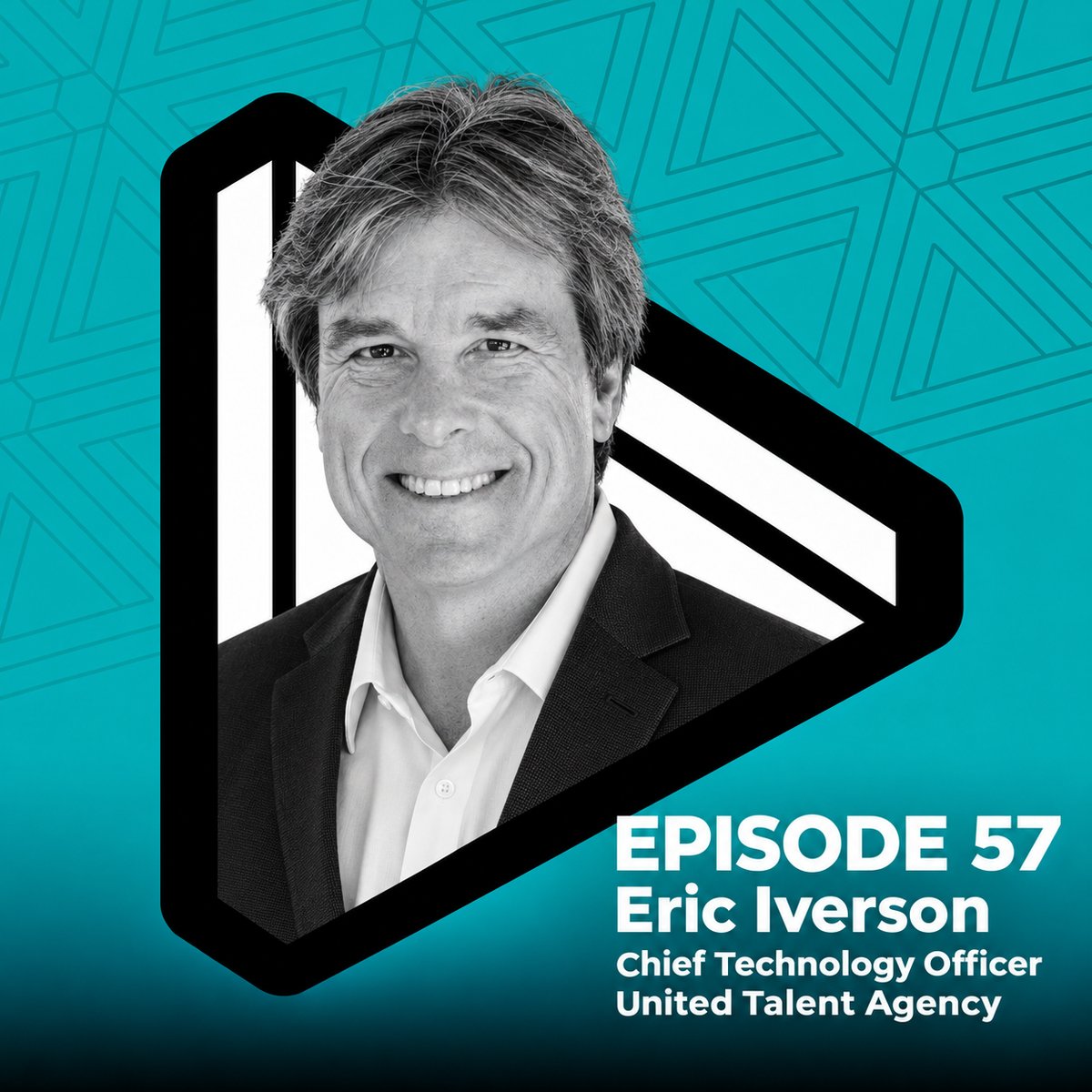
In this episode of Technically Creative, Orlando Wood sits down with Eric Iverson, Chief Technology Officer of United Talent Agency (UTA), one of the most influential technology executives in Hollywood.
With a career spanning Sony, Creative Artists Agency (CAA), Amazon and UTA, Eric has watched technology change entertainment from nearly every angle. Today he works at the intersection of technology, business and creativity at an agency representing about 13,000 clients across film, television, music, sports and the creator economy.
Eric shares his view on generative AI, copyright, artist compensation, digital likeness protection and the future of talent representation. He explains why this shift will be driven by artists themselves, how virtual production is opening new creative possibilities, and why human expertise still matters.
Watch the conversation
Orlando and Eric explore
- How UTA uses technology, data and AI to support talent
- Hollywood's evolution from Sony and streaming to generative AI
- AI copyright, fair use and protecting artists' intellectual property
- The future of filmmaking, virtual production and human creativity
- The rise of the creator economy and entrepreneurial talent
- Why creative companies must prioritize cybersecurity and data infrastructure
Key questions
Who is Eric Iverson?
Eric Iverson is the Chief Technology Officer of United Talent Agency (UTA). Before UTA he worked in technology at Sony, Creative Artists Agency (CAA) and Amazon, including AWS. He is also a jazz musician.
What does technology do inside a talent agency?
Eric describes four main customer groups for UTA's technology teams: the clients the agency represents, the agents who look after them, the brands UTA works with, and the buyers, such as studios and promoters, who book talent. Work as basic as paying clients accurately and on time is part of the job.
Why does Eric Iverson say data comes before AI?
In his words, AI is only useful with good data: bad data gives bad AI and good data gives good AI. UTA tracks client performance across box office, television, streaming, music platforms, ticket sales and social media, where the average follower count of its creator clients is about 1.5 million.
How does UTA approach AI and artists' rights?
Eric says artists should receive attribution and compensation for their work, and that most concerns artists raise about AI are valid. UTA trains its staff on a balanced view: not all AI is good and not all AI is bad, and misuse such as unauthorized digital likenesses has to be dealt with through law, ethics and social norms.
What should a mid-size creative company prioritize in its technology?
Eric's advice is to patch systems faster, simplify so there are fewer things to manage and fewer exposed services, use trusted SaaS platforms, bring in professional help such as a fractional CISO, and be data first, with good information architecture and the discipline to keep it organized.
Chapter markers
- [00:00] Introduction: Meet Hollywood's CTO
- [01:36] What a Talent Agency Actually Does
- [08:12] Four Customer Groups: Clients, Agents, Brands and Buyers
- [12:38] Why AI Is Only as Good as Your Data
- [20:44] Inside Sony's R&D Culture
- [29:56] From CAA to Amazon to UTA: Seeing the Creator Shift
- [34:10] Why Creatives, Not Studios, Will Drive Generative AI
- [38:05] The Artist Mindset: A Musician's First AI Animation
- [48:38] Virtual Production and Real-Time Filmmaking
- [54:49] Faster Production and the Pressure on Directors
- [1:01:56] Listening to Artists: Attribution, Compensation and Likeness
- [1:10:05] What a Mid-Size Creative Company Should Prioritize
- [1:11:13] A Thought Experiment on Fair Use
- [1:12:45] Cybersecurity, Simplification and Fractional CISOs
- [1:17:16] Be Data First
United Talent Agency: unitedtalent.com
Transcript
Read the transcript Show
Orlando (00:01) Okay, great. awesome. Eric Iverson, I'm so glad we're finally getting to do this. Thank you so much for coming on the podcast.
Eric Iverson (00:11) My pleasure. I'm excited about this too.
Orlando (00:14) well good. You know, we've seen each other at panels and conferences and I always refer to you affectionately as Hollywood CTO. may you know, partly because you've been at so many amazing places. And I hope this doesn't embarrass you, but you're the coolest CTO I've ever met. You know, the hair, the way you dress, you're like a CTO with swagger. so yeah, that's a Hollywood CTO. That's how I think of you in my mind.
Eric Iverson (00:34) Ha ha.
Eric Iverson (00:37) Well, I can't elaborate on that's super kind of you, and it's pleasure to be here, but it it's actually it's a great honor to work with so many great technologists in our industry, so very very kind.
Orlando (00:47) Yeah. well, listen, it's a pleasure. And and you know, you've had this incredibly unusual path. You're the you're the CTO of UTA. You've had this unusual path through Sony, CAA, Amazon, now UTA, which means you've watched technology kind of reshape entertainment from almost every angle, from the studio, especially a studio with such technology chops, you know, in Sony, an agency, the platform, now the talent business. What's interesting to me is that UTA was early to understanding the creator revolution, you know, and so for our audience across multiple creative industries beyond film and TV and the creator economy, what do they need to understand about what you do and where technology sits inside an agency like two UTA and the problem you're ultimately responsible for solving?
Eric Iverson (01:36) Yeah, great question. Well, you know, one thing I might do is just kind of start with the mystery of an agency. Because I think like you if you'd be working around the business enough, you probably like you probably understand what an agency does, but it's generally a mystery to everybody. I think when I started working at CA a long time ago, even even I had to kind of make some mental
Orlando (01:40) Mm-hmm. Sure.
Eric Iverson (01:54) mental shifts kind of myself. But, you know, I think the easiest way to think about it is is that you know, if we it doesn't really matter. If you if you aware in entertainment that you want to start. If you if you think about the with the place I go when I think of entertainment is a streaming platform or I I go to a movie theater or I like watching the NFL or the NBA or I love listening to music. Any of one of those places, we have platforms that we go to. We go to Spotify or we go to Netflix, whatever it is. Like you have a place, an outlet, a place that you go to. behind the scenes for every one of those things, every one of them, there is someone that is the artist, they are the actor, they are the writer, they are one of the things that is going to make that show happen. And like I always like to say in sports, all athletes in some ways are just actors. It's the world's just a most amazing real time drama is what we're actually watching. And and so you have you have all these and so what we do is we you know, we represent, you know,
Orlando (02:47) Yeah. Yeah.
Eric Iverson (02:53) 13,000 super interesting people that make their whole entire life making this content that is is entertainment. But I you know, I've really kind of over the years kind of evolved that to saying it's culture. And what I what I why I say that, and and maybe that resonates with you too, is sure, it's entertainment. But so many people that are in this business, they definitely think about it a lot more than than just entertainment. They, you know, if they're an author, they may really care about their work or the the movie that they're making may actually have significant cultural relevance to them. And, you know, they're you could think of a lot of like pretty epic film or TV shows that have been made that actually have a s had a big impact on culture because they're trying to make a point or tell a story. And so we work with those, I'll call them storytellers. They're they kind of the foundation of everything that we do. And all of us work together. I it's not that these people are necessarily more important. We are an ecosystem and it's one of the things you probably love about this industry. It's what I love about it.
Orlando (03:50) Hundred percent.
Eric Iverson (03:51) We all work together. Period. We are one hundred percent reliant on all of our friends to you know, in this ecosystem. Talent need studios to produce things. They like it when you have a platform to to go on and those platforms rely on talent and creators. So what we're our job is to do is to make sure that we create the maximum amount of opportunities for these creative storytellers, these cultural sparks to find their voices into basically the right audiences and the right places and help them navigate that career. And what makes me really passionate about it is I don't you have such a great radio voice. I always think it's like you must be in something. You must be in something. But if if you if you haven't, you probably have a friend or something that's been into something. This is this is not an easy business. Like th these to stay at the highest level, the highest level of someone that's gonna have relevancy in culture is an extreme amount of work.
Orlando (04:29) Okay. Yeah. Yeah. Yeah. Yeah.
Eric Iverson (04:46) incredible amount of talent, it could disappear in a in a short period of time. And and so like how do you how do you really kind of nurture kind of those careers and find those opportunities and and and and make sure that you could help them in this along along this you know really difficult business. And there may be, you know, a very small subset of the of the kind of the the population it makes the really extraordinary larger dollars. But the majority of the people that all of us that work in entertainment and culture are not in that you know, that higher level, which I'm happy for and aspire to and actually help fund other parts of the industry. And so that's what do we do? I think that we make sure that we find opportunity and and you know, you know, incredibly good jobs for all these people that are working really hard every day and they shouldn't be spending all their time thinking about how do I get to my next gig can we get some help to do that. And that's what an agency does. We're connecting the dots and we do that in many creative ways. And we could talk more about that. But I think what we're seeing right now, you see we you talked about creators, right? I think the what we're seeing that kind of that rise of the creator kind of part of the the economy continuously is creating
Orlando (05:43) Yeah.
Orlando (05:49) Sure.
Orlando (05:59) Yeah, and it also feels like like even if you're not a creator, you're expected to live your life out loud and and tell a story of your life, even if you are an actor or a writer, or you know, that that that sort of intrusion or or opportunity is coming into your life a lot more. It's a sort of expectation, I would imagine.
Eric Iverson (06:18) Yeah, for sure. I I think there's no question about that. I think like it and that's across all of entertainment. That's not that and that's why I really feel like why I keep calling it's the rise of the entrepreneurship is what we're seeing right now. And if you looked at what you just talked about, that's actually somewhat personal branding. That's your personal market, your personal marketing, which is it could be exhausting and they're always on all the time and trying to feel like that you need to have that culture of voice out there. But but for many, many talented
Orlando (06:24) Yeah.
Orlando (06:28) Mm-hmm. Yeah.
Eric Iverson (06:47) artists that is a part of their their life and some of them obviously love it and they're amazing at it. but it but it yeah, that that is an ongoing part of their life. And that's why we you know in sports, you know, in college sports right now, you have you know NIL or right, N I L V we might talk about in Hollywood, you know, name, image and likeness. That's you know, and and and one one factor for that is is that like how marketable are you as a college athlete and one
Orlando (07:01) Yeah.
Orlando (07:14) Yeah.
Eric Iverson (07:16) One aspect is how good of a an athlete you are and another one is how popular you are and how much of a cultural voice do you have, right?
Orlando (07:23) Yeah. I feel like you're you're in an interesting position, you know, in your role at an agency because it feels like we're at this moment where you have two clients at any given time. You're supporting the infrastructure that supports the agents and the executives and the data teams. And now there's so much more reliance and importance on data for all sorts of people for for music touring and comedy touring and and all those sorts of things. But at the same time, the agency is being relied on by talent to support them in their creative infrastructure and their techno technological in infrastructure. How do you balance those roles and how do you who do you see as your sort of primary client, as it were?
Eric Iverson (08:12) Yeah. Balance. We're still working on the balance that 'cause we're we're working a lot of hours. But yeah, exactly. yeah, no, first of all, terrific question. And what I might say like the way I I would kind of view the world, our team our technical teams view the world is I I may say I've kind of four big customer groups, you know, if we kind of grouped our customer groups. customer one group, I would kind of say in the kind of like if in a UTA client you know, client first, client centric, kind of
Orlando (08:15) I think everybody is, yeah. Yeah.
Eric Iverson (08:42) principle, you know, our our clients at the end of the day, we want to make sure that they do really well. And if I used a a simple example of like thinking about what the client needs, pro basic things. Like if you said, like, hey, what does what does a client really care about at the end of the day? And one of those top answers is gonna be making sure that they get paid on time for the work that they did. Just like anybody else in our normal life, we would do a job we expect to get, you know, paid and paid on time and paid the right amount. And so, you know, when you look at like
Orlando (09:02) Yeah. Mm-hmm.
Eric Iverson (09:12) Processing these very complex client you know, client statements and payments, and to the teams that all need to get compensated in that process, you know, that's a complic complicated thing, and you want to do it right, really well, fast, and accurate. Well, you might say, like, well, who's that for? Well, at the end of the day, I think that's actually for the client. And we gotta make sure that that's a capability, a core capability of the platform. So that's one of many things like that. So let's say the client and kind of round trip back to that because I I think that might be kind of the future world. Number two, I think is just behind it is the is the agent. And the reason I look at I look at it that way is that they're the ones on the front line every day that is responsible for that relationship with the clients and making sure they're the ones that are spending their entire day making sure that they have the right opportunities, they're negotiating the right opportunities, they're finding them. So what are we doing to unlock their specific ability to actually support the client. So if we said client number one, then I would say kind of agent number two. And it's it is a different set of you know requirements and and that one's actually kind of fun if you think about it, because in some ways I kind I consider it like the I don't know, maybe the internal tender of the work that we do, which is a lot of a lot of the work you do, if you imagine this, like if you have one you know you got ten thousand clients in the company, there's some magic, secret sauce between that can happen at any point in time, connecting the dots the right way.
Orlando (10:27) Yeah.
Eric Iverson (10:40) And how do you do that? How do you create serendipitous moments where two agents might come together that never would have thought to actually create a really super interesting cultural moment or or something like that for for that. So the the next group I I might kind of say which is related, so once you have like we'll say I'm I'm actually probably enhanced client to representative clients, representation business. we work with brands and and we work with brands in
Orlando (10:49) Yeah.
Orlando (11:02) Mm-hmm. Right.
Eric Iverson (11:09) as as c customers and clients as well. And so we also serve them across those. So if you have really interesting people and you have agents that can find opportunities to find the one of the bi groups that they're going to find opportunities with is all of the brands out there that actually might to wanna interact with culture. And we see that all the time. And that's becoming, I think, more and more common. Like how does a brand tell the cultural story that they want to tell? And so That's where we we kind of like there's storytelling for entertainment culture and there's storytelling that relates to brands and companies that are trying to tell their story. And then the last kind of major category I would probably say out there would be the buyers. And that one maybe seem seeming to be less obvious, but to me, I actually think what I you know, I would like to see and we're gonna work towards is like how do we become easily you know, the easiest company to do business with. And I would like to make sure that, you know, Live Nation and Disney and and whoever it is that we're working with, we make it super easy to do business with us. And and so I look at them as customers too. So so those are c those are some big customer groups. And of course we have like the whole corporate infrastructure that supports all the above for sure. And so you know that we'll give that as a given, but those that's how we think about it. And so
Orlando (12:27) Yeah. And how big a r sorry, sorry, go ahead.
Eric Iverson (12:31) Yeah, so I I know there's a c separate question about balance, which is kind of a little bit of a separate thing, but at least that's kind of like the the core customer groups there.
Orlando (12:34) Yeah. Yeah, yeah.
Orlando (12:38) Yeah, I mean how b how big a role is data playing in that in those relationships?
Eric Iverson (12:44) Yeah, it's it's essential. I mean even my conversations today. I could actually boil a lot of my day down to like probably three or four things. Of course, I have to say AI at some point in time because it's just required for me to say AI as a technologist. So there we go. We got that out of the way. But I I know, exactly. So but here's here's the thing, and it it's the simplest thing. You know this, everyone's a practitioner i in our industry knows this. AI is only useful with good data. Period.
Orlando (12:57) Don't worry, if you hadn't gone there, I would have.
Eric Iverson (13:11) Like you know, if with bad data you get bad AI, with good data you get good AI. But but data and AI is the lifeblood of interconnecting all of all aspects of your agents and your clients together. And so that is definitely top priority across the board for us and and you can imagine that's pretty complex because you know easy way I might kind of say, like if you want to think of like the the complexity challenge that we might have is if if you just worked Like at the NFL or you worked on it with an NFL team and th they do amazing work. they have a ton of data. If you kind of grew up in that space, I grew up playing baseball. Baseball loves data. We l we track every single thing you could possibly imagine. And now we like track the kind of s you know, spin rotations on a baseball and a pitch. You know, I mean they're they're gonna track something else new that they haven't figured out how to track next year. So we we track a lot of data in just every single sports league, right? You've seen that.
Orlando (13:51) Yeah. Yeah.
Orlando (13:59) Right.
Eric Iverson (14:08) Well, we represent clients in every sports league or or all of these major sports leagues, right? So when it comes to, you know, working with players, like we somewhat have to be familiar with all the player data in the NFL, but we also have to be really smart about the player data in the MBA and smart about the player data when it comes to, you know, European s soccer players over European football players. And so the complexity we have on the data side is we have internal client data, but when it comes to kind of how they show up in the world, we need to know that too. So it's the same thing with box office performance, when it comes to television performance, when it comes to streaming performance, when it comes to definitely streaming performance on different music platforms, tickets like our ticket sales, and that's kind of a tricky one all of by itself. So yeah, I think one of the challenges that we have is there's as an agency, we can't be necessarily
Orlando (14:50) Yeah.
Eric Iverson (15:01) is focused as just one a a maybe a kind of a pure play market segment, maybe able to be kind of focused down to a still a lot of data. No no not complaining about it. But our somewhat our challenge a little bit is like almost like an overwhelming amount of data. You you're kind of almost like you're you're at that point you're kind of a sitting almost like a a three letter, you know, agent I guess we're a three letter agency, right? But but you know I mean it's like, you know, the that we you're kind of trying to collect the you're trying to look at culture, you know, and I didn't add them up. This is
Orlando (15:11) Yeah.
Orlando (15:22) Yeah. Yeah. Well it's used as a that's used a paj as a pejorative usually unless you are the biggest one, which you guys are. You know, like the biggest, like what you know.
Eric Iverson (15:34) Yeah, yeah. Well, here's 'cause here's the crazy thing. That this is so for anyone that's listening, like I know that this is not a deduplicated number, so that'll be just started out. But if you just take the followers of our kind of creator clients and the ones that are kind of on s on social, you get to twenty billion people. Now there's not twenty billion people on the planet earth, but what I'm trying to just kinda point out when we're talking about data at scale. That's a it one point five million followers is the average follower of one of our clients. That's I don't have one I mean, you're probably gonna get one point five million if you're on the way, but but it's a pretty big number. You know, it's a but to point it out, it's like you go out to like and you work with like other companies and brands, it's like how many brands have like one point five like every one of these people has that kind of that kind of reach and that's reaching on different platforms to different places. So
Orlando (16:09) Yeah, that's amazing.
Orlando (16:13) Some sometime in the distant future, but you know, yeah, yeah.
Orlando (16:22) Yeah. Yeah, that's inc incredible.
Eric Iverson (16:30) I'd probably give you a long answer to the the data question, but for sure it's like top top of the list of of things that we're trying to be really good at.
Orlando (16:34) No, I love it.
Orlando (16:38) Yeah, I mean, you know, because I feel like that's such an important part of it. I think that like, you know, there are obviously aggregators on the the client side, you know, and they can have off-the-shelf SaaS tools and and their own trackers of engagement and things like that. But what you guys are dipping into is far more real data of, like you said, ticket sales and box office and, you know, and you know, how many tour tickets are sold at how many different venues and and things like that. It seems to me that that, you know. As the business becomes more data driven and platform mediated, is representation becoming is the in is the technology infrastructure layer that you're kind of tapped into a bigger, a bigger part of the offering to clients that actually by coming to UTA, they're entering this sort of technological dome of data and opportunity and and things like that and and protection that that that really both protects and augments their careers moving forward.
Eric Iverson (17:41) Yeah, for sure. I I think there's no question about it. I mean, one of the things that we have a UTA, one of my colleagues, Joe Kessler runs a group called IQ, UTA IQ, Stephanie Smith and they have folks and and they're in they're involved directly with clients all the time on doing well say specialized data analytics for for clients to help them understand things. So we actually devote a whole department to that. We we're we're you know, building the technology substrate to make it easier for them to do their jobs and for us to scale that. No question that that is you know a priority for us and a priority for the offering that we have to serve clients the best. And and we will continue on that path. you hit the nail on the head. Like as you can imagine if the if you were, you know, when you get to your 1.5 million plus followers, you would you would kind of expect that. You would kind of expect to come to us and for us to give you
Orlando (18:22) Yeah.
Orlando (18:34) Yeah.
Eric Iverson (18:35) I think two parts of insights are probably on the expectation. One is that you kind of like know all of the basics but do a better job than the average person. You would ex doubt your expectation. The second though, and we expect this, you know, I I think in the world of AI we we do research and we go out there, but then we still go talk to somebody, right? You know, and with and we go talk to people that we feel like are experts in that area, or feel to like double check even the AI math on that. And that's the second thing that you would get from us, which is
Orlando (18:44) Yeah.
Orlando (18:55) Yeah.
Orlando (19:03) Yeah.
Eric Iverson (19:05) you know, kind of experience and then you could like go take a look at that data and then you have a c a a a sane conversation about where to go with that. And I think it's the mix of those t both of those two things. And one of the things that I'm so impressed with is some of the agents here that have really just off the charts insights to you know where they think things are gonna go in the future because that is here i I I really want to double down on this comment. It gets underappreciated, but humans and human data and human prediction and human creativity is data as well. And so it just happens to be locked into people. And so what we actually want to do is take data at scale and marry that up with really important expertise data and then bring those two things together. So that that's kind of like the magic format.
Orlando (19:52) Yeah. It's it's funny. I mean, I think that like I think what's it's so cool. I'm and I'm interested. You were at CAA. you I mean, I I do want to get into I don't often look back at people's careers, but I love your career because you were sort of you were at Sony, and it always seemed to me like Sony had the promise and of so much because they had BMG, they had artists, they had the technology. They sort of were Apple before Apple. you know, knew what was up, you know, before iTunes. If they were but they weren't n maybe talking to one another the way they should have been. you know what? I was gonna skip to the agency part of that. Let's talk about that for a second. you know, because was that you were there around that time. I mean, around the time of the mini-disc player and things like that. Was that a frustrating or exciting time to be at at Sony?
Eric Iverson (20:22) Yeah.
Eric Iverson (20:44) Yeah, super exciting. Look, I you know, I I'll give you a couple of great stories on it, but I I still love Sony. I think it's a great company. and I if anything, because I was just over the Sony lot like a week and a half ago, they they ran a really nice event over there, which which I'll tell you about. But but you know, Sony undersells themselves as a tech company. I think we go, hey, who are the tech companies in Hollywood? We go, like Netflix and Google and whatnot. But I think part of it is in it I wish
Orlando (20:50) Yeah. Yeah.
Orlando (21:05) I agree. Yeah. Yeah.
Orlando (21:12) Everybody's like, Yeah, the tech companies are coming. And you're like, they landed in nineteen eighty nine or whatever it was. Like Yeah, yeah. Yeah.
Eric Iverson (21:16) Yeah. Absolutely. Absolutely. And and I think maybe it's because the kind of tech that they're in or and I think part of it is also because of the
Orlando (21:24) Yeah. Isn't threatening in the same way. It's not Silicon Valley Digital Tech. Yeah.
Eric Iverson (21:30) Something, yeah, yeah. But you know, they number one gaming platform, you know, that you have out there, which, you know, they've dri driven a ton of innovation on that. But they have so much underlying technology that they do out there. And so they spend billions of dollars on R and D every year. So one of the things I always love to you know, I got a chance to go several times out to is in and th this will probably be interesting to you, but s and this is but kind of almost helps helps you understand the Sony culture. So
Orlando (21:58) Yeah.
Eric Iverson (21:58) I think you don't really know Sony until you go to Tokyo. You don't know Sony until you go to Tokyo. And when you go out there, what you realize is like super passionate people. Like I I think like I remember I'm being out there and I think it like on year fift fifteen or something like that. I was meeting with a bunch of people. And at year fifteen, I was definitely the by far and away most least tenured person in the room. Like it was so many people have been there thirty years, thirty two years, and they love the company. but that company is started as an engineering company.
Orlando (22:01) Right. Yeah.
Orlando (22:12) Yeah.
Orlando (22:18) Right. Yeah, yeah. Yeah. Mm-hmm.
Eric Iverson (22:28) They were a tech first company. And and so when you go out there you realize that they're very, very passionate about technology. they love consumer electronics, but just technology in general. And they do a lot of R and D. And so the the other thing about that that culture, if you've ever have you been out ever been out to Japan and Tokyo and
Orlando (22:47) I have been out to Japan. I absolutely adore it. I mean, look at all the neon in here. I'm like I'm basically turning Japanese in here.
Eric Iverson (22:51) It's amazing place, right? It's amazing place. Like you look at you. You are you're like, yeah, yeah. Yeah, absolutely. that's right. Konichiwa. All right. So yeah, I love it. So the so you it when you go out there, the thing is it's like it's this incredibly respectful culture. Like that's how I found it. It's like, you know, it's the cleanest Tokyo's one of the it's gotta be the cleanest big city of its size on the planet. And
Orlando (22:59) Tchotkis everywhere. Like I'm you know, it's it's a culture built for my Yeah
Orlando (23:17) Yeah. Yeah.
Eric Iverson (23:19) And so because of that, there's a this like enormous amount of respect on how R and D is done and how they talk about it in a way that I actually really like. And they they tend to be a kind of a company that's like, I'll go build it and then we'll show people and talk about it, as opposed to it's a little bit more like a American you know, Silicon Valley is like you talk like you literally haven't even written a line of code or anything about it, and you're you're talking about like this product as if it's been production for six years.
Orlando (23:40) Yeah. Yeah. Yeah, you're already on your series B. Yeah, yeah, yeah, yeah.
Eric Iverson (23:47) Yeah, yeah, exactly. Series F and you still haven't like built anything yet. But but but out there so they have it. So w they actually created this something they called Sony Technology Exchange Fair, Steph, and it was a a it's a big internal science fair so that all of the different groups that work on research can kind of come together and get to see some of the the product work that they're working on. And I saw I mean I could still even today's standards, you know, like saw some pretty extraordinary things like you know, learn learning to, you know, they basically made like Blu-ray discs with you know this is like fifth ten you ten years ago with multi multi terabytes of storage made on stone discs that could last two thousand years for archival. And it was like not sure I need that, but that's cool. Like you know what I mean? And so that's like like, you know what I mean? Like stuff that no one else has. And they still make some of the very best cameras in the world. Like there's a couple of incredible
Orlando (24:34) Yeah. Yeah, very cool. Yeah. Yeah.
Orlando (24:43) Yeah.
Eric Iverson (24:44) Can camera manufacturers, you'll find them in all your consumer products. And so it is definitely a high tech research company at its core that also is in the entertainment space. And so it was an incredible time to be out there. And I think that, you know, it was really unfortunate there was a couple like almost innovators dilemma type of mistake misses on that. You know, like I I actually still own a mini disc, a couple. but 'cause it but yeah, you brought it up.
Orlando (25:06) Yeah. Yeah. Well I was gonna say I brought up the mini disc. That that seems to be one of Yeah.
Eric Iverson (25:14) Yeah, exactly. Well, you know, and that that was the struggle because, you know, the innovators' dilemma issue on that was that the mini disc was created at the same time as that we were trying to figure out hard disk, and whether or not that was a better format. And, you know, they they wanted to keep selling medium. And and so because of that, that they they ended up kind of landing up Yeah, in cassette tapes and things like that. They manufactured them, right? And so
Orlando (25:32) Yeah. Yeah, 'cause they were making so much money off the VHS tapes, right? Yeah. Yeah. Yeah.
Eric Iverson (25:42) So the mini disc was cool, actually. the best use, you know, the best use case really was for the mini disc at the time was me as a music because I'm also a musician was was it was great for that. Like if you want to go record something, high belly, you know, digital recording and it definitely had a lot of music friends that were kind of like using it for that capacity, but that's not gonna that's not gonna be the device to kind of get you to the kind of the the next generation walkman. but
Orlando (26:06) Yeah, but also I bet i it i it it it did its job better for you, I'm sure, like actually making music, 'cause you were making music, which meant you got girls. I was making them mixtapes on a mini disc, not quite as effective.
Eric Iverson (26:21) Yeah, well y I play jazz, so like maybe maybe less there on that. But but no, it's all good. It's it's it's yeah, it's still cool, I guess. Trump a player. But the yeah, so but but it was a great time. So the other thing is it's like it was a an incredible in the you know, big portion of the time I was there, innovative spirit. They you would they took the lead on I don't know if you ever really remember the movie fly became Movie Link Project, which was really the first project that the
Orlando (26:25) Well Okay, it cuts both ways. Yeah, yeah.
Orlando (26:40) Mm-hmm.
Orlando (26:50) yeah.
Eric Iverson (26:50) The studios there was five studios that came together at the time and said, we don't want to have Napster two point Let's just make sure there's a legitimate offering out there. So we could say, like, here's a legitimate offering. You don't have to go steal music. So that that was a project in Sony took the lead that was actually being done right off ints, right? you know, kind of there. Well, I actually think it was fine at the time. That eventually got sold off to Blockbuster.
Orlando (26:57) Yeah.
Orlando (27:04) Yeah.
Orlando (27:10) Yeah. And they were just too early on that, huh?
Orlando (27:19) Right.
Eric Iverson (27:19) And what what I think actually kinda happened is actually that Netflix was so focused and took off so well that that actually Netflix actually became kind of like the okay, well, at least we have like Netflix and there was, you know, a couple of other players out there. but then and but then the second thing they had going on at the same time, which was only Sony, and it was like only if they would have continued on. But they had actually kind of created whether you want to call Facebook before Facebook or or YouTube before YouTube, they had a product they called Screen Blast. And it was actually pretty amazing for its time. It was it was definitely years ahead of its time where it was allowed you to kind of go create, publish, share your videos, and it had online editing built into it. and that's that's pretty incredible for like early two thousands, you know what I mean? So so anyway, I so anyway, very inova innovative time. I think if you were there you also gotta have like cross collaboration with
Orlando (28:03) Yeah.
Orlando (28:08) Yeah.
Orlando (28:13) Yeah.
Eric Iverson (28:16) with music and Playstation and whatnot. I think l learning for any large company. Go ahead.
Orlando (28:19) Yeah. Well, it's funny because yeah, like I feel like understanding that they're they started as a tech company, and we think of tech companies now as as much more open in the way ideas are shared. But what you're kind of explaining is that actually being a tech company back then meant that there were lots of siloed pieces of responsibility and ownership, and you focused very much in your domain. And you didn't share outside of it. You were trusted, and I think, especially in Japanese culture, you were trusted to do what you do, do it in an excellent manner, and then have your piece join with the whole at some point. and so weirdly, when we see Sony as having made a mistake in some ways from not bringing those things together holistically, actually, that's a much more modern view of that, you know, of that company at that time, whereas actually. They were doing what had worked for a tech company for ages at that point.
Eric Iverson (29:18) Yeah. Yeah. No, I think that's exactly right. And you know, I think in in some ways, like maybe the lessons learned out of that. so I I still think Sony's a great company. They just did this a event on the lot and I saw some amazing product that came out over there. I again I would say I do consider them like the for whatever reason, maybe maybe because they're not as much in your face right now on the consumer electronics and they've moved a little bit more to B2B. But I I definitely think that we
Orlando (29:27) Yeah.
Orlando (29:30) Yeah.
Eric Iverson (29:44) we probably under represent them as a technology company. and great people over there. So anyway, I like you said, like it's it's great culture, good people doing great work. So anyway, it was a great time. I I like love love that love my time there. Yeah. So that was great. Yeah.
Orlando (29:50) Yeah.
Orlando (29:56) Yeah, I bet. Yeah, yeah. I mean, you know, you you then moved to CAA, and I've I've kind of heard you say before that the reason for that move is that actually you kind of saw a lot of the creator shifts happening a lot earlier, and that maybe actually you were sort of a bit too early in that respect for CAA. And then now UTA, I think people don't realize how early to the creator. economy or or creator landscape, UTA has been. It feels like, you know, you and UTA coming back together feels kind of like a match made in heaven. What what has that realization been like from from where you were seeing the opportunity in, you know, in working at an agency to now being at an agency that feels like the right fit?
Eric Iverson (30:48) Yeah, no, I think look I I I I'm very grateful for all like parts of my career journey for sure. And if we've got to work to add, you know, really great people across the board. you know, I think that the you know the the initial thesis when I you know I got the call about that gig was simply You know, we and we were watching this real time. 'Cause you know, we also had so if you remember Crackle, which you I that was part of a television portfolio at the time. That was after it didn't do screen blast, eventually it actually re-ac did an acquisition which you can looked up of a company called Grouper. Grouper was a UGC site, also kind of in that space, and then they pivoted Grouper back more to kind of like the y I'll say kind of professional narrative type of platform.
Orlando (31:23) Yeah. Yeah.
Eric Iverson (31:37) but it being in and around that space, like who is going to be creating things on Crackle at the time, made you know, we and you were kind of seeing kind of a little bit at the already at the time of kind of like your rise of YouTube and and social. I was like, wow, it's really interesting. The trend line to me, you know, and that was 2016, was like I definitely see like individuals becoming brands and you know, businesses. And so, you know, getting to go work on the on the agency side, you know, I think was, you know, kind of like the thinking there. And you know, when you're you know, l learning a new space. I mean I think that you you you're trying to cut up what a you know kind of like how d how does this new shift work which you know with a you know also inside of a company that does a lot of motion picture work. and so so I I think it was kind of a true thing and then taking somewhat a little bit of a a break going back to Amazon and AWS and then going like very h horizontal on the AWS role and then back to studios. It it was almost like a slightly different version of that before
Orlando (32:26) Yeah.
Orlando (32:38) Yeah.
Eric Iverson (32:43) coming back to UTA and that was a little bit of wow the the shift that I saw which really fascinated me. So the so actually the the first shift probably was correct. Like I do think if you would back to 2016 and if you said hey in 2016 you think that the creators thing is going to become a big thing and then you fast forward today you're like yep you you were probably at least directionally like maybe maybe you know maybe maybe others saw it better than I did but kind of directionally correct. And then I think that if you looked at
Orlando (33:02) Yeah. Yeah.
Eric Iverson (33:12) you know, what what we were kind of seeing at Amazon, which is like with generative media taking off and kind of being at the nexus of that. And in you know, great company. I I loved my time at Amazon, you know, gre excellent company. But you know, one of the things that was super interesting to me was that we were having a lot of conversation about how's generative media gonna help production and the thing that the light bulb started going off, at least for me in my head, which is, this is super interesting because at least every other major shift in Hollywood
Orlando (33:17) Yeah.
Eric Iverson (33:41) has been heavily driven by on the this kind of like studio platform tech side. You know, it's like whether it was like a Sony trying to like launch a platform or Netflix coming in or, you know, ba basically all of yeah Disney launching Disney Plus. I mean, all of those things were like heavily driven somewhat out of either a tech company or the studio or a studio tech company, right? this one was like, well who makes content? Well actually st studios, what do they do? They hire creative people.
Orlando (34:09) Yeah. Yeah.
Eric Iverson (34:10) that make content. So the big shift was was really gonna be it's like the ad the key adoption point in my mind wasn't how the studios were going to use generative media. It was how were the creatives going to use generative media that work on projects for the studios. And it was like, this is gonna be an interesting, fun problem. And look, I grew up as a, you know, kind of in
Orlando (34:25) Mm-hmm. Yeah.
Eric Iverson (34:31) is a musician and a creative myself. And so I that's that I think that's always just been a part of my heart. And so going back and being in a role where we can I could spend my all day, every day just focused on one thing is like, how do I help other creative you know, and and better than me, you know, like incredibly creative, successful artist.
Orlando (34:41) Mm-hmm. Yeah.
Eric Iverson (34:53) make this transition, succeed through that trans transition in this like hard hard business space, seemed like a really, really good fit. And, you know, and lo and behold, I think you you have in You know, kind of UTA is kind of like the company that has been, you know, you know, very focused on being kind of a modern company, leaning into kind of like the intersection of culture, technology, and artistry. And that's kind of been a little bit of the the ethos here. And you saw that with kind of like C A sorry, UTA's early entrance into creators, which was you know, way, way before my time. I had nothing to do with that, but that that group has such done a great job. and and just kind of being
Orlando (35:13) Yeah.
Orlando (35:19) Yeah.
Eric Iverson (35:36) really thoughtful about like in intentionally wanting to lean into and figure out the best way to navigate that as a priority. That that has been terrific and and yeah that my colleagues here are amazing like and and some of our clients you know they're they're definitely trailblazers you know in various aspects of this huge huge shift we're going through so
Orlando (35:56) Yeah.
Orlando (35:59) Yeah, I think that that like, you know, what you just said there, I think is so great. Cause we've been, you know, I I I our head of business development, Rachel, who's also kind of, you know, manages everybody. She like keeps everything running on on time. And she kind of said to me the other day that, you know, we we want a kind of perspective on who we hire and why. And we've been hiring so much so fast, and it's it's been great, but we really kind of codify that. We think that the best technologists that we can work with, especially in what we do, which is mainly for creative companies, are people who have a background, either a subject matter expertise where they've worked in a job, or at very least, their hobbies are creative. You know, we want people, technologists, who have been screenwriters. we've been waiting for a guy who you know, we're hiring as a senior platform engineer. he We were trying to hire him last November, and he was like, I'm kind of out for nine months because I'm putting a play on at a black box theater in in New York off Broadway. And I'm gonna be doing that for the next six months. So, you know, I'm maybe this isn't the right time. And I'm like, we'll wait for you. Like that to me is so valuable. And just hearing you talk about your experience as a musician, and I'm my attitude is like, whether it's a hobby or not, it lives in your heart in a very special way. And I think that that is such a unique and wonderful skill to be bringing to the table in your job, especially now, where technology, art, creativity, likeness, copyright, all of these things are converging in this bottleneck that is technology. And I just did think, you know, like, so yeah, I have other things I want to talk about, but I just wanted to say, like, that to me. Is is why I hear such amazing things about you from others, why I've wanted to have this conversation so so long. Is it's really I think it's a really important thing and it's a it's a quality that really meets the moment we're in right now.
Eric Iverson (38:05) Yeah, well I appreciate you saying that. I mean, first of all, I I couldn't agree with you more and I'll if you don't mind me telling a little story that it's just really recently happened, to me to kind of put an exclamation point on this. But kind of what you're talking about is almost having the artist mindset. The artist mindset to your work. And and actually I think like software developers and product managers a lot of them do have that artic my mi mindset. I'm a builder, I'm gonna go do this, you know, that kind of thing that like keeps you up to three o'clock in the morning and you're actually sad that you had to get two hours of sleep.
Orlando (38:11) Sure. Yeah.
Orlando (38:19) Mm. Yeah. Yeah.
Orlando (38:28) Mm. Yeah.
Orlando (38:33) Right, yeah.
Eric Iverson (38:34) But so I so I got a call like a I don't know like a few weeks ago now, and from and I'm gonna have to leave the artist out name quiet for now, but at at a future date, we're gonna come back and unveil this incredible work. So I get this call, it's like, hey
Orlando (38:43) Sure, that's fine. Yeah. We did this dance with Andre at CAA as well. He was like, and I'm gonna tell you a story, I'm not gonna tell you what's about.
Eric Iverson (38:52) There you go.
Eric Iverson (38:56) That's right. That's right. So so we so I get this call, it's like, they you know, they we have these like this really interesting musical artist and they they have done this project and like this really interesting project and they told me about it, and like, that's w what a great idea. And and we'll just say that I I guarantee every single person listening to here has heard this person do what they do. So you know, very, very well known. And so they had this idea about some that was kind of inspired by kind of a a a space related event that that happened and it was but a very human event like the the the the it's very human so far the story. And so they when they started making music for this, they kind of it was somewhat like visualized these characters and immediately from the beginning they're like and and th and they would also like dealing with very real things, you know, like you know like hand drawn hand drawn characters and things like that. And and they were like, gosh, we really want to we wanna tell animate this story. Like this is an animation, but we want it to be super authentic. How do we do that? And they r had no background at all in generative media. At like z zero background. I mean I I just like complete beginners. And what does a musician do? They don't really think like they don't know something. I don't know how to tell you this and describe this any other way.
Orlando (40:06) Yeah. Yeah. Yeah.
Eric Iverson (40:21) They're like, like and I think it comes up like the for with like this, and I can't tell you how many people like I I play multiple intro instruments and there's kind of this thing that's like in I don't know if you have you play music or you have other friends that play music, but there's kind of this like Yeah, okay. But there's this kind of thing that's like and I've seen this with the the so many in instrumentalists I know they actually play multiple instruments and they may play one of the other ones and not be that great about it, but it kind of doesn't bother them. Like it's like, well play that one.
Orlando (40:21) Yeah. Yeah.
Orlando (40:33) X incredibly badly. Yeah.
Orlando (40:44) Yeah. Yeah. Right.
Eric Iverson (40:50) Well then I'm gonna go play that one. And they just kinda like lean into it and you're like, actually they picked that up pretty fast. And but it's kind of like of how a five year old would learn. Like they they really are pretty fearless of leaning into that. And so this person had done all kinds of innovation and and it's interesting how detailed like a musician will get because they have to work with a lot of technical tools, right? Like think of mixers and amplifiers and things that may yeah, kind of change the sound and and
Orlando (40:52) Yeah.
Orlando (40:56) Yeah. Yeah, yeah. Yeah.
Orlando (41:18) Yeah.
Eric Iverson (41:19) you know, how they're gonna include that in and you know, you're you're you're working with you know, kind of editing softwares or pro tools, all things. So they actually get pretty familiar with working all these tools without actually kind of thinking about it. You know, they actually become pretty technical. And music in itself is kind of technical. So they just had no fear. They're like, well this is the thing we want to do. And they looked it up and like, well we could use these tools. And so they went out and sort of these two tools. So, you know, fast forward, they're like, well, w we we need some help. Like this is kind of what we did.
Orlando (41:32) Yeah, yeah.
Eric Iverson (41:48) And but we really don't know what we're doing. And then they showed me what what they did and my jaw dropped to the floor. I'm like, this is some of the if you didn't tell me like that they walked into this not knowing what they were doing, I would have said, yeah, these are guys are pros and like, you know, you know, these they've been doing generative media, they're AI first and all that. And then you learned how they went to do it and they just like somewhat hacked their way through the whole process. And what seemed to work and which was super fascinating to me was
Orlando (42:00) Yeah.
Orlando (42:13) Right.
Eric Iverson (42:18) They had such an artist eye for it that they just were pissed off at that the tools weren't giving them the outputs. And then they would just were l relentless about making the tool, bending the tool, finally getting it to do what they want to do. Like a musician would finally get the sound that they're trying to get out of their instrument. And the output was off the charts amazing. And I'm excited to for eventually these works to like get out in the world. And could have they done it
Orlando (42:20) Yeah.
Orlando (42:29) Hm. Yeah. Yeah. Yeah.
Eric Iverson (42:47) sixty percent easier if they actually had all the training, yeah. But here's the crazy thing. I'm not sure anyone ever would have actually come up with something better.
Orlando (42:50) Yeah.
Orlando (42:56) Right. Yeah, you're right. Like the the friction itself is part of the creative process. Like there's that that great scene with Jack White in It Might Get Loud where he's talking about a broken guitar and the joy he finds in extracting a sound from it.
Eric Iverson (42:58) And you know what I mean? And so there's this Yeah.
Eric Iverson (43:10) Right.
Eric Iverson (43:14) That is like a perfect analogy. So so I think that's back to like why I I I'm sorry we probably lingered on this topic so much, but I I'm super passionate about it and and it is just kind of this recent experience. And in fact actually talking with them, they actually even said this and when we were all done about and was like, you know, I I just want to encourage you to like keep going and and it was kind of this comment about it's like, yeah, like when you you know, some musicians are come from different kind of forms of training and when you kind of like pick it up and go, there's a fearlessness.
Orlando (43:21) No, good. Keep going. Yeah.
Orlando (43:33) Yeah. That's cool.
Orlando (43:40) Mm.
Orlando (43:43) Yeah.
Eric Iverson (43:44) and almost like a a possibility of everything that kinda comes with that. And so I think that's the spirit that you b it sounds like you guys appreciate in in some of the the people you like to hire, me too. And I just feel like that's a it's like a reawakening of like who we all were born like, you know what I mean? So
Orlando (43:47) Yeah.
Orlando (43:58) Yeah. Yeah, a hundred percent. I mean, I think it's it's yeah, it's great to kind of see that happening more now is that people are getting to sort of bridge two sides of themselves into one place, you know, and and I think that like a lot of the the yeah, a lot of the stuff that we're seeing people kind of struggle with or get excited about are, you know, are are scratching two sides of their brain. And I think that like we're we're in this moment now where you kind of get to do both in one session, which which is a great opportunity. It I think it's it's very scary in many respects. But I think that like what we are trying to do especially is make sure that we're hiring people who have that other side to themselves. Cause our perspective really is that at the end of the day. As we all move forward into the new world of the just the new disruption of production, I think we want to have as many people leading that charge who have a deep respect for where it's come from. And if you've sweat and labored over and had three days of writer's block, you know, or
Eric Iverson (45:05) Amen.
Orlando (45:13) You've, you know, you can't get your, you know, the thing that you're trying to get with the guitar writer, whatever those things are, that struggle, that friction is part of the misery and the joy of creation. And I think so much of, you know, when Silicon Valley is like, it's gonna be easier. You can do it this way now. You're welcome. And it's like, we don't really want it to be all that easier. We we want the friction, we court the friction to a degree. We just need to figure out where. We're the bow bending and where we're the string pulling, you know?
Eric Iverson (45:46) Yeah, for sure. And maybe the other thing I might add to it, which is like, you know, not to overuse Steve Jobs, but I suppose if you have a a podcast you have to bring up Steve Jobs at some point in in it. But but you know
Orlando (45:55) It you'd be surprised. Taylor Swift came up on this podcast before Steve Jobs did. Maybe that's an indication of where we're moving as a culture.
Eric Iverson (46:01) There you there you go. is is you know, if you think about like some of the ways that he approached design, it was also in that very kind of very same fashion. So I think it's struggle.
Orlando (46:10) Mm. Yeah. Yeah.
Eric Iverson (46:15) But I also think it's like a very high standard, which is like I have a vision of where this is supposed to go, what great looks like, you know, if I'm building software or doing a solution or a creative output that we stay focused on it. And what's interesting is because I it was having some you know, it's the beginning of the school year, here in Southern California, so it was like parent initiation night last night. And and of course I work in technology so e
Orlando (46:18) Yeah.
Orlando (46:21) Mm. Yeah.
Eric Iverson (46:39) You can g imagine I get a thousand questions always from parents, tell me about AI or what's going on with AI. So it's like, you know, the the token AI guy at the table. But you know, one of the things that you know, a lot of parents c have concerns about right now is some form of like, you know, brain rot or like that we're starting to check out a little bit because now we don't have to think so hard and all of that. And and I think what you you see in the artist approach.
Orlando (46:48) Yeah.
Orlando (46:57) Yeah. Yeah.
Eric Iverson (47:07) to technology and creativity is that these are still just tools and I'm actually doing the other way around. I'm challenging the tools. I'm getting mad at the tools that they don't give me the output. What we actually are worried is the opposite of that, which is that we see, you know,
Orlando (47:11) Mm-hmm.
Orlando (47:17) Yeah.
Eric Iverson (47:22) y you know, maybe a student, like actually not putting any effort into it because they're like they're trying to get done with the job and like, give me the output. Or a software development, give me the output. Or that's what creates AI slop. ha ha ha funny, give me the output. What's great look like? What's a great story? What what am I actually challenging the tool set and I'm actually that's what we've always been excited about as creative technologists. It's like and actually I was on I was on a call I I will call them out to this this morning 'cause they're amazing. But the Diamond Brothers.
Orlando (47:25) Mm-hmm.
Orlando (47:29) Yeah.
Orlando (47:34) Yeah. Yeah.
Orlando (47:43) Yeah.
Eric Iverson (47:50) who are clients of ours, and you should you you look up. They they're definitely leaders in immersive technology. And a lot of the call the the conversation we were having and they're they're so creative and and it's and super fun by the way. They should be on your show at some point. But but they yeah, I'll I'll send them over. But they you know it's kind of it's like they're always like it's almost like
Orlando (48:04) we'd love to. Send our way.
Eric Iverson (48:12) Like they're trying, like even the conversation we're having today, it's like what I really need the camera to do and like, you know, and like it just kind of imagined 'cause that's not giving them the result of the next thing that they're pushing towards, right? And that's that's the I think the spirit on you know, whether you're, you know, an AI software developer or you're a creative creative artist using these tools, I think that's that's kind of the North Star that we want.
Orlando (48:18) Yeah. Mm-hmm. Yeah.
Orlando (48:38) Yeah, absolutely. So we we brought up AI. I'd be remiss if I didn't didn't bring it up. I mean, obviously, you know, I think that what you saw in that in what was coming with creators was obviously the the democratization of distribution. You know, like the social media age is the the expression of the major disruption to the distribution systems. And that's really all of the Entertainment companies, that's what they're reeling from right now. They're, you know, they're not competing against AI movies. A lot of people are blaming AI and pointing at AI, but they're not competing against a lot of AI slot movies that are coming out and in the theaters and and whatever else. What they're competing against and what's eating their lunch a lot is the attention economy that has moved online and and gone towards social. Now, what we're seeing obviously in AI is this disruption of production. And suddenly Tools and capabilities that had to be in a flame suite or had to be, you know, done by Framestore or, you know, Technicolor when it was around and things like that, that disruption is now here for production. And that does that is going to change some things. AWS and Amazon are doing some amazing things with the Wonder Project and things like that. You know, but fantastic.
Eric Iverson (49:54) Yeah. John Er John Irwin's one of our clients. So yeah, he's doing yeah, he's in and I definitely think he's like one of our our you know top examples of like using these tools in a good way, you know. And he's very artist first, the outputs are amazing, they're iterating and using it in tasteful ways. Yeah, I mean terrific. He's a terrific artist, you know.
Orlando (50:08) unbelievable. I mean, I that yeah. He's got many messages from me waiting in his inbox. I have because yeah, yeah. I mean, listen, the the the thing that I found so inspiring about that thing that he did was, I mean, even Sir Ben Kingsley is going, I was amazed at like my mirror neurons were firing. I expected my feet to get wet when the water. Came in and I was looking at the volume stage and I'm hearing and seeing ocean water coming at me. I couldn't believe my feet were dry. And for me, as somebody who's a reformed producer, for me, seeing the editor on set, the VFX guys on set, the production designer working with the volume operator, the person who's doing the Unreal Engine, all of that technological expertise, pre-production expertise, and production expertise. Sitting around the same table on the same day, that was the first time I looked at something and I went, every fun conversation I get to have in pre-production, production, and post gets jammed into the actual production experience. Can I think of anything more collaborative and awesome? Like that, that was the first time I went, we haven't lost something here. It's possible we've gained something.
Eric Iverson (51:20) Together.
Eric Iverson (51:31) I totally agree. I you know what? yeah, I I joked about it earlier, but someone that plays jazz, it's it's almost like I feel like we're we're bringing we're finally we're bringing jazz to like narrative production and still doesn't make any money, but but you know, I think but that c that but but you just nailed it, that vibe of everyone collectively being able to be creative simultaneously at the same time. I actually think
Orlando (51:39) Yeah.
Orlando (51:42) Jazz is finally relevant again. Well done, Eric.
Orlando (51:58) Yeah.
Eric Iverson (51:59) raises the bar on on certain things. And I don't think it takes away from you still have the ability to kind of fix things in post too, but I think it creates a a new opportunity of sparking moments that that you could do kind of live and and where kind of like your real time creativity can kind of take over and and I think that's a great thing. And so yeah, I mean and that's what's so cool about it is it's like people, you know, we overindex in the AI, but what's what's really fun is that we're seeing is a combination of several technologies.
Orlando (52:01) Yeah.
Orlando (52:09) Yeah.
Orlando (52:21) Yeah.
Eric Iverson (52:30) and you know, this is kind of one of the patterns I think we've been seeing is like virtual production is been that's been a great step forward for us. And then you know, ability to use kind of game engines that came in to LED, you know, panel walls and then that was kind of a game changer. And now we're ability to put assets and change them in real time to bring them into that environment. that's where the generative AI piece takes, you know, takes a a big role. And then, you know, being able to add, you know, additional like
Orlando (52:37) Yeah.
Orlando (52:43) Yeah.
Eric Iverson (52:59) BFX plating into that that maybe would have been really expensive to do, but certainly not near real time. Those are that's all game changing, I think, for for a for a production. So I agree with you. I think I think it brings a sense of of fun and and you kind of real real time you know, I don't know, I I might even say improvisation to, you know, of the the production process that is being unlocked.
Orlando (53:07) Yeah. Yeah.
Orlando (53:23) Yeah.
Orlando (53:27) Yeah, I mean, and I also like the economics of it, by the way. I mean, you know, like if you're if that was done in two weeks on a volume stage, then you have twenty-six two-week blocks every year, right? And if you were to theoretically fill every stage at Warner Brothers, 46 stages, with a volume stage, producing, you know, 26 blocks a year each, you're talking about over a thousand films a year. Now, I'm not saying that's where it's gonna go, but but I do like the the numbers that I see there. And it's like, let's not forget Hollywood used to be a factory town. I mean, when the studios granted the studios had contract deals with actors and that wasn't great and things like that, but it was a churning out product, you know, like that's part of Hollywood's DNA.
Eric Iverson (54:03) Yeah.
Eric Iverson (54:07) No, but but that's but you are correct. You you are you there's no question that I mean that's actually a really great insight. I I agree with that. If you go back in time, somewhat the studio design became out to that was exactly because of that. It's like, great, we wanna shoot a western, we wanna you know, we wanna shoot an underwater scene. Let's just have all of those things here in one place so that we could just bring everyone in, keep going, keep shooting.
Orlando (54:23) Yeah.
Eric Iverson (54:37) And be as efficient as possible. We'll have you know, we're gonna have a construction department that's right here that can build everything. And that's why studios look like they do today.
Orlando (54:38) Yeah.
Orlando (54:44) Yeah. 3D printer sitting off there, you need a new prop for tomorrow. Don't worry, boss. It's coming, you know?
Eric Iverson (54:49) Yeah. Yeah, for sure. Now, I mean, I think the human part, you know, so first of all, I think that y you know, there's there's lots of positive things about making certain aspects of a production process, you know, more cost effective. You know, that's in and I don't think that's a new concept. I mean, I think that we've been seeing that for a long time, right? I mean it it's in fact probably the the single biggest ship that we had before is when we went from film to digital and and then we started outputting ten to a hundred times more
Orlando (55:08) No.
Eric Iverson (55:19) content because of that because it was easier, more cost effective, and it gave us more options. But I think if you you know, kind of the one thing that's kind of interesting here is is that and I've heard this from some directors, is that the the pressure on the director in particular. So it's like, you know, you squeeze the balloon and it has effects on different people. Well here's the thing. If if you have a production, in let's say I'll Momo Wang who who you know, came out of traditional filmmaking. Yeah, she's kind of talked about this before, but if you if you have a production that you know went over the course of I'm making this up six months, it doesn't really matter, and you have to make a number of like directorial decisions over that, and I reduced that by fifty percent or seventy five percent, I still make the same number of editorial decisions, but over a much shorter period of time.
Orlando (56:16) Yeah. Yeah.
Eric Iverson (56:16) So it's a long way of saying is certain roles have run the risk of beginning somewhat getting stressed out a little bit because they're going so fast. So so there is good. I I think that there'll be an adjustment and that there's always some like unintended consequences from these processes. And maybe the only other one that I've I I think is legitimate and and I could this also resonates with me. While I think it's amazing to be able to create this kind of improvisational, all real time and have that kind of
Orlando (56:23) yeah, for sure.
Orlando (56:30) Yeah.
Eric Iverson (56:45) creative hyper creative moments, you know, because you can bring everything together. some creativity happens over time. And it's so and so I think like for certain things where like time plays a role, like how do we not lose I'll call the human pondering that sometimes i w is an important part. So if you imagine you have a longer production, there's some of that pondering creativity
Orlando (56:55) yeah, for sure.
Orlando (57:05) Yeah.
Eric Iverson (57:13) happens out. So I I I don't think that we've you know, we're in the process of kind of this shrinking of being able to make things quicker, which is awesome. but I do think the pondering part of creativity, I think we'll have to kind of figure out w where where does that where does that manifest or re manifest and I don't have a great answer to that, but but yeah, so I I but I do think that
Orlando (57:21) Yeah.
Orlando (57:26) Yeah.
Orlando (57:30) Yeah. I think the hope is that some things, you know, some things are marathons and some things are sprints and that there will actually be these just new classes of production. Most importantly, new classes of g green lightable films, you know. Like, I mean, only one percent of screenplays that have ever been written have ever been produced. I mean, there's there's a huge amount of dreams sitting in, you know, in storage units somewhere that, you know, that yeah, yeah.
Eric Iverson (57:58) Email boxes, lockers, yeah, yeah, no for sure. And and that to be it actually that's to me is the the promise that gets me almost maybe most excited, which is I I have you know talked to a number of indie filmmakers and you wait when they kind of see some of these tools, it does kind of unlock in in several cases you've seen it, it's like a film idea that they have that it's somewhat they've almost written off as impossible. Like, I've always wanted to do this, but I'll probably not make it in my
Orlando (58:06) Yeah.
Orlando (58:24) Yeah.
Eric Iverson (58:27) time, but it's a great idea. And actually going, wait a second, I actually might go see about it maybe within reach, you know, and and and I do think that we're gonna see some really cool content coming from that direction. And and you and you know, you look at a you know some clients of ours that you know came out this year, like Obsession, you know, that you know come kind of creator creators and kind of went into that. And I think being able to kind of unlock new ways of of making film
Orlando (58:27) Yeah. Yeah, yeah. Yeah. It's within reach now. Yeah.
Orlando (58:46) Yeah.
Eric Iverson (58:55) in story from you know, I I think is is good. But yeah, I think we'll have more paths. but I I I still think that we'll wanna have s I don't know, I could be wrong, but I still think that for larger productions if you're making the Odyssey or something that's bigger and more complex and whatnot. I still think that, you know, kind of like the studio system model, you know, for us, I mean, yeah, great. I'd love s you know, studios to keep making film for a long time. I have literally nothing
Orlando (59:01) Mm-hmm. Yeah.
Orlando (59:11) Mm.
Eric Iverson (59:23) N nothing bad to say against that. I think we just wanna make sure that it it happens. I think the friction will be i and here here is and they maybe in the c the technically creative thing that I think we'll have to work through. This is more of a technical problem. We we we almost we've seen this, if you're a technologist, you've dealt with this problem a million times and we have this on the technology side. It's like, yeah, it comes out. That software you were gonna make, it's gonna take like one quarter of the amount of you know, cost and effort now. And you're like, Well, maybe not. I mean like it's still like there's
Orlando (59:51) Yeah.
Eric Iverson (59:51) We still gotta talk to everybody and you know, you know, maybe there's certain parts of it that we could do quickly, but maybe there's a bunch of complexity and then we end up having to iterate through it. So I do think that while it's gonna be amazing that there's gonna be parts of the production process that maybe don't add a lot of value compared to the production part. They're not part of the storytelling, it's not part of the human performance, it's not part of the the writer's work, that we'll be able to kind of you know, help get completed more efficiently. I also want to make sure that we're being realistic when we're making film that it's like, okay, well, not all of the cost is gonna go away. We still have human performance and all these things that are still a big part of it as well. So so I do think that they're you know, we're probably working through a little over indexing on the kind of the the opportunities there, but but still I I still think all all in all my optimistic self would be is wherever we've seen this trend in the past.
Orlando (1:00:23) Yeah.
Orlando (1:00:33) Yeah.
Orlando (1:00:40) Yeah, I think that's true. Yeah.
Eric Iverson (1:00:51) usually it's turned out better for the creators in the long run. I think we have more places and more platforms that creative people can distribute their content. And yeah, and we we certainly had our golden age of streaming when we you know able to create that platform outlet.
Orlando (1:00:55) Uh-huh.
Orlando (1:01:03) Yeah.
Orlando (1:01:12) Yeah. I mean, I spoke to Duncan Crabtree Ireland from SAGAFTRA on the podcast. And and one of the ideas we kept coming back to was that actors and musicians, especially, may be the first creative workers whose labor identity, body, and and voice and and can all be technologically separated from the person. You know, I feel like what I love about you is is your optimistic and curious. When When talent comes to you with those kinds of concerns or or when when they come into your technological ecosystem, how do you help them move through those sorts of this sorts of technological shakeup and those sorts of concerns?
Eric Iverson (1:01:56) Yeah, I think I think two things. I think one is you know, being as honest as you can about i well let's just start with the technology. I think the first one is facts. What does the technology do and what does it not do? how does it work? What are we actually what are we actually talking about? and so I think that's that's the first thing is to coming from a place of education. probably but probably even the very first thing is just listening. I mean, do you really understand the concerns? And I would actually say 99% of the time, I think all of the concerns I've heard are actually really valid points. and in many, many cases, in in probably almost all the cases, I'm like, yeah, I actually I agree with that point. It's why I like doing what I'm doing. You know, if you think of things like attribution, do you if you ask me, do I do I think artists should be receive attribution and compensation for their work? Absolutely one trillion percent. I couldn't think of something I feel more passionately about. And and so
Orlando (1:02:32) Yeah, for sure.
Orlando (1:02:38) Yeah.
Orlando (1:02:53) Yeah.
Eric Iverson (1:02:55) I mean that but that's always been a concern. I think it's just gotten highlighted, you know, in you know, earlier concerns on that might have been like piracy. If someone like s you know, stole the work and didn't you the artists and the the copyright holders, no one's getting any compensation for that. So we have a new a a new way that we can, you know, like not, you know, respect that. And
Orlando (1:03:03) Yeah, for sure.
Eric Iverson (1:03:20) And I think the other thing that gets lost in the mix, and this is the thing that I like working in our industry, I'll bet you like this about our industry too. And this I'm gonna go back to the culture thing. I think it's a very much you know, i i if you've worked in this industry long enough, you realize that the people that work in the industry and make these stories are culturally really in tune with the world. Well, if you're a really great storyteller, there's so many things that you have you understand about the human condition.
Orlando (1:03:42) Yeah.
Orlando (1:03:49) Mm-hmm.
Eric Iverson (1:03:49) And if you tell science fiction stories, you're telling stories about trouble that can happen in the future and how to maybe consider that and avoid that. And how many science fiction stories have then been followed by either policy changes or are used a lot of movies have ended up in congressional hearings as references for things that we need to fix and do. And so
Orlando (1:04:07) It's really good point. Yeah. Yeah. Yeah. Yeah.
Eric Iverson (1:04:17) We we are not just in the storytelling business as for entertainment. We are in the storytelling business for culture. And and they're very passionately about it. So when they talk about their concerns and issues, it's n it's not just about just me, but it's like how is this like these are the questions everyone should be asking, right? Is just like in the science fiction movie that went bad, you know, it's like that the Jurassic Park famous quote about, you know, everyone you we spent so much time thinking about if we could, no one acts, you know, spent a second to think if we should, right? That line is written by someone that made a movie about that in this condition that entered into culture is something for us to kind of consider and plays a relevant moment right now. And so I think that's what we're seeing right now. And so I think listening to those real concerns and not just at an individual how what's what's it mean for me and what's it mean for SAG and the industry? But actually I think a lot of the concerns that are being raised are universal concerns. What does that mean for all humans? You know, if you think about it, it's like,
Orlando (1:04:58) Yeah.
Orlando (1:05:12) I totally agree.
Eric Iverson (1:05:15) let's talk about we're worried about, you know, let's say in our case, like, you know, if if you we had a couple cases that got out there with like Brian Cranston's name, image of likeness and voice that, you know, that's you could read that in the LA Times got out and were misrepresented. But what if that was your daughter? I you know what I mean? Like that's a human problem. Like, yeah, I mean, y you I think we pick on
Orlando (1:05:24) Yeah.
Orlando (1:05:29) Yeah.
Orlando (1:05:33) Yeah. Well, not to mention their their life's work is their performance. To be scrolling through Instagram and suddenly be presented with your face giving a performance you did not approve of, you did not sign on to, you know, is it must be incredibly disconcerting. Yeah. If somebody was out there peddling a piece of technology, being like Orlando made this and it was crap, I'd be like, get out of town. Like I don't want my name associated with this at all. Yeah. Yeah.
Eric Iverson (1:05:49) And you don't want. Yeah, yeah.
Eric Iverson (1:05:59) Right. Exactly. So so so anyway, so I love those issues and and I think they're they're very real. And I think I I think being just pretty balanced in the way that we kind of talk about this issue. And I think that's the one thing I really appreciate about my my boss, but the way that we kind of approach it here at UTA, which is this very, very balanced view, which is, you know, that simply this and we actually do training inside the company on this. Not all AI is good, not all AI is bad, you know, and
Orlando (1:06:26) Yeah. Yeah.
Eric Iverson (1:06:28) You know, there's I you know, like I could go to the far end of other end of the spectrum, my whole family's in medicine. And if you said, Hey, great, we used computer vision to help early spot, you know, what could potentially be cancerous tumor and the radiologist missed it, I'd go, That's a pretty good use of AI. Like that's who's gonna complain about that? You know, if that was your mom and it caught, you know, some err you know, early signs of a cancer early and you could do something about it. That's
Orlando (1:06:47) Yeah. Yeah.
Orlando (1:06:54) Yeah.
Eric Iverson (1:06:58) That's good I. So let's let's be honest, there's some really good use cases for it. And then there's misuse of it, right? Like I could take a deep fake and and fake out and pretend that that was, you know, your daughter calling in distress and needing money for something. And that's a total misuse of it. And and and we've always had that with technology, right? That whatever good can be done with the tool, there could be bad done with the tool. And I actually think that is where kind of our laws, moral ethics and norms, social norms all have to play a role.
Orlando (1:06:59) Yeah.
Orlando (1:07:12) Yeah. Yeah. Yeah.
Orlando (1:07:21) Mm-hmm.
Eric Iverson (1:07:28) Back to why I love our industry so much, because we keep telling stories that signal like good choices and bad choices that we make as a civilization. And so that's what I love. We work we're working with storytellers that their voice is incredibly important that those topics. And and so and then I think you backtrack from that. And I do think that there is kind of like a what's the impact of the industry. And then this is where I think you and I and everyone that sits almost like at this I love keep lovingly looking at your technically creative glowing neon sign up there, by the
Orlando (1:07:30) Yeah.
Orlando (1:07:35) Mm. Yeah.
Orlando (1:07:57) I'm irrationally proud of it.
Eric Iverson (1:07:58) But I no, I love it. I love it. I keep looking, it's like, yeah, I need one of those. Like, I you know what, can I get one of those? But but I think that that we that probably see can see both sides of these two issues coming together. I you know, I I feel that's kind of wakes me up in the morning every day. It's like, how do we bring those parties together? And and just to put in perspective, that I probably had four of my meetings today in my daily t day today
Orlando (1:08:24) Yeah.
Eric Iverson (1:08:28) on this some version of this topic. I mean that's like it's not like a part-time part of my job. That's something it's an everyday part of er of my of my job is to like how do we help how do we land this in a good place for humans. And I'll keep saying this and I'll you you could you could take run me the bank on it. But I I will argue that storytelling is, if not the most one of the most actually human activities that humans do. So we are
Orlando (1:08:30) Yeah.
Orlando (1:08:33) Yeah.
Orlando (1:08:52) I hundred percent agree. Yeah.
Eric Iverson (1:08:55) So when I think of like us protecting artists and actors and whatnot, I think we're kind of we're we're actually protecting the human condition at the same time and j as we do that.
Orlando (1:09:02) Yeah.
Orlando (1:09:06) Yeah. Well, Eric, I've I've kept you over time. Can I ask you one more question? Okay. Well, thank you very much. I'm yeah, I'm really enjoying this as well. I just, you know, one of the things that I think is is our insight is that there's obviously there's there's large companies like UTA and the big studios and big creative organizations that have invested in their own tech. They have a CTO, all of those sorts of things. Then there's a huge go the moment you get out of that.
Eric Iverson (1:09:11) You can ask me 13 questions. I love talking to you.
Orlando (1:09:34) There's this sort of huge gulf of people not having a head of IT, not having a CTO, not having somebody who's protecting and and overseeing their tech stack. And I think there's this huge gulf. And now when these AI tools can come into your business, and we've already seen them, I don't believe personally in the fair use argument. I think it's kind of crap. I think, you know, I think that we've witnessed the largest copyright theft of all time. And so much of what we try to tell people is before you do anything else, secure your environment.
Eric Iverson (1:10:02) Yeah.
Orlando (1:10:05) There's this huge gulf that I've noticed. If you were talking to a company that is outside of the top tier and they're a creative company thinking about their relationship to their own tech and they're a creative business, whether it be a publishing company, a design company, advertising agency, small studio, production company, they're thinking about their own tech. What would you tell them to prioritize first?
Eric Iverson (1:10:31) so that would be maybe the smaller the smaller tech company. What would they should provide us? mid size?
Orlando (1:10:35) I'd say like I'd say like mid-tier to lower successful 30-person advertising agency, production company that maybe has an IT person, but it's probably like the young guy they hired that, like, you're young, you understand this stuff. Do our security infrastructure. Like, you know, I I find that there's a huge gulf there of a like an IT capability or technology capability gap. If you were sort of speaking to them, would you say,
Eric Iverson (1:10:42) Yeah. Yeah, yeah.
Eric Iverson (1:10:54) Yeah, yeah, yeah. Okay.
Orlando (1:11:03) Keep doing what you're doing. Don't worry about it until you become big enough. Or would you go, this is how you need to think about your own tech and your own relationship to your tech stack?
Eric Iverson (1:11:13) Yeah, yeah, for sure. So I'll I'll give it if you don't mind, I'm gonna go back to the the other thing you said on the i is as far as when it comes to fair use. But here here's here's the easy thought experiment. You're gonna you you're gonna like this one. But I I encourage everyone out there. It's like, you know, h you we I I'm kind of aligned with you on the fair the fair use problem, but it's here's the easy argument any like model company. It's like, yeah, but let's say we we put everything in and like it's it's it's we put it all into the content blender and it really doesn't have like
Orlando (1:11:22) Sure. Sure.
Eric Iverson (1:11:41) you know, like maybe some of the professional content isn't influencing it that much. And I was like, yeah, great. So let's do an experiment then. What I'd like you to do is take out all of the professional content from your model and see how good the output's gonna be. Because here's what I'm gonna tell you. It's only the top one percent of that really great content is the only thing that we care to have come out the other side because what we are looking for is actually really great pr professional content.
Orlando (1:11:52) Yeah, yeah. Yeah, yeah. Yeah. Yeah.
Orlando (1:12:03) Yeah. Yeah, yeah.
Eric Iverson (1:12:06) So it's honestly, let's be honest, it's the super pros that are getting hosed. It's not all of the other junk. Let's just be really honest, because that's that's that's really the good stuff. So anyway
Orlando (1:12:10) Yeah. yeah. We made a we made a model that had no copyright training in it. It taught it spoke very much like a lawyer. You know.
Eric Iverson (1:12:21) So yeah, so anyway, so I I think you can make that argument several ways, but I was just like, yeah, great, let's do the thought experiment. Let's just just take it out. Just take it out. so yeah, so anyway, to your point, I I that's an amazing question. So first thing I would say is you know, a a couple good rules of thumb. One is you know, the cybersecurity
Orlando (1:12:27) Yeah. Yeah. Yeah.
Eric Iverson (1:12:45) issue is real, like you know, we we we lovingly call like a mythos or I I my I got a couple articles sent to me about I don't know if you've been following like the mythos problem and yeah. So we call it pat patchmaguetton is like having so all the patch patching that that needs to happen. So I've saw a couple good articles articles on patchmaguetton. but but right now urgently you everybody needs to be thinking about how do I patch my systems a lot faster.
Orlando (1:12:54) very much.
Eric Iverson (1:13:13) And this is going to be going on for a while. So if I were a smaller, mid sized company, what I would probably be looking for is how how do I make that less of my problem? Because I need to like focus my efforts. So do I have like trusted SAS flap SaaS platforms that are automatically doing that on our behalf? and and so that's so the other thing I would just say simplification. And I
Orlando (1:13:30) Mm-hmm. Yeah.
Eric Iverson (1:13:37) Th in some ways I actually think this is a little bit of the problem with AI. A all of a sudden when AI came out, like every single person on the planet feels like they're a software engineer all of a sudden. but but they're actually not. but they're creative and I and I appreciate that. So I first of all I'd encourage everyone to to learn how to use tools and whether it's Claude or lovable or whatever it is that you wanna to practice on. However, the c technical requirements of being a professional haven't gone away. If anything, they've gotten harder.
Orlando (1:13:45) Yeah, yeah, yeah.
Orlando (1:14:06) Yeah.
Eric Iverson (1:14:06) Managing an infrastructure has gotten harder. And so I would say making sure that you have professionals doing those parts of the job. And if we went way back in time, you know, you know, studios used to run their own power company. If we use the studio model, and then they're like, No, no, no, Edison, you could do it. Yeah, maybe we have power here, and maybe we have a substation here, but I actually don't want to run the infrastructure. in tech in technology, you know, cloud technology has come along to do that. And there's certainly a debate on cost and whether you you want
Orlando (1:14:19) Mm-hmm. Yeah. Gone. Yeah. Yeah. Yeah.
Eric Iverson (1:14:35) It internally. But I would say if you're gonna run your own infrastructure, you better be you're gonna have to make this a priority. So is that a priority? I would say pick your battles. What what is it that you want to have do? So simplification, have fewer things that you have to manage, fewer threat surfaces, and then be really thoughtful about what's exposed to the internet, what's not exposed to the internet when it comes to security. But I do think that you're gonna everyone should really in this moment, right now.
Orlando (1:14:50) huh.
Orlando (1:15:04) Mm-hmm.
Eric Iverson (1:15:04) If you're not doing it as one of these kind of like you know knee jerk reaction moments where every one you know, every like four years something happens and all of a sudden we have to take cybersecurity more seriously. That is in the ray right now, you should be doing that. Like it's we're we're already seeing that in what kind of creative attempts that are coming in. Phishing is gonna get a lot more sophisticated, we're already seeing that. But we're just on the earlier days, but you in I don't know if you've been following this, but
Orlando (1:15:14) Yeah. Yeah.
Orlando (1:15:25) Yeah.
Eric Iverson (1:15:30) You know, if you went back like about, I don't know, seven years ago, it was about two point six years from the point in time where you saw vulnerability, I get identified for it to be productionalized and for it to be used in in on companies, that is now down to days.
Orlando (1:15:46) Yeah. Yeah.
Eric Iverson (1:15:49) in in that short period of time. So so being able to kind of keep up with that, I would so I would say a couple other things. Like, you know, if you don't if you can't you're a small company, like the things I've seen is like fractional C CISOs. Get someone that really is a pro, make sure that you're getting that kind of support. Tied into one of these larger companies. and I would actually just make and take their advice. Like you if you're a a tech professional, you probably feel the same way. If you think that you need to be
Orlando (1:15:53) Mm-hmm.
Orlando (1:16:04) Hundred percent.
Eric Iverson (1:16:17) the pro on everything that is possible on the planet right now, you have a hundred percent failure rate because it's happening too fast, there's too many technologies out there. So if you could simplify down your room, your your threat landscape. And then also I think you want to make sure that you're getting professional help and you're getting that specialization out there. You know, SAS platforms if you're a smaller company. and then if you have builder capability, which I'm a big fan of builder. So I am a big fan of builder.
Orlando (1:16:22) yeah.
Orlando (1:16:37) Yeah.
Orlando (1:16:46) Mm-hmm. Yeah.
Eric Iverson (1:16:47) but just make sure that's a really professional team and maybe it's the infrastructure that that you're working with or you're you're doing you have a so that capability, but you're you're at you are tied with a larger company that, you know, and make you know making this up, but you know, maybe you're tied with a software development company that you know has you know pretty deep capability. So they're providing maybe some architectural guidance. And then you you know you have a safe sandbox to go like go build in, you know, inside of. And so
Orlando (1:16:53) Yeah.
Orlando (1:17:14) Yeah.
Eric Iverson (1:17:16) That's probably the advice I would probably give is just be mindful about your partners, your friends, getting competency with it, staying simple. And and then the most important thing I think for all companies that'll get back to what we talked about earlier, just be data first. I think that so many companies get led astray by shiny objects of things that look good. But if you think about what moves the needle typically in organizations, it's workflows.
Orlando (1:17:46) Mm-hmm.
Eric Iverson (1:17:46) it's insights, it's intelligence about you and your business, and that's all driven actually by your data infrastructure. And and so I th I would be really mindful about that. And so
Orlando (1:17:54) Yeah. And it's the one thing they can't replicate. I mean, I've I feel like GPT, Anthropic, these are company, private companies that are about to justify a multi-trillion dollar IPO. In order to justify that kind of valuation, they are going to have to compete in every major industry in the world. Gambling, sports, entertainment, le law, finance, they have to compete just to justify their their you know their their existence. And so like, If you have data that's yours, for God's sake, have security be the first thing you think about so that your teams aren't just firing it off in their personal unprotected, you know, GPT accounts. Yeah.
Eric Iverson (1:18:39) That's right. And it and it's one of those things where it's like, y you've seen this in probably i any I can see like you look at your background, it's like the beautifully organized. But you know, that's the thing. It's if you have a habit, if you have a habit of that, like a clean shop floor, you know what I mean, and you have a habit of making sure they that we're organized, what what is what is good data management? Good data management is a combination of good information architecture. Everything is well thought through, it has a place to go, like
Orlando (1:18:54) Mm-hmm. Yeah.
Eric Iverson (1:19:05) your cubbies up there have like they're designed to have certain kinds of things in them. and we have a place to put them.
Orlando (1:19:10) I keep telling my wife there's a method to this badness. She just doesn't believe me. But I'm glad you see it.
Eric Iverson (1:19:14) Yes. You can see. and it and so I think that so that's part of it that you have a design to that and then you have discipline. And actually again, I keep going back to you probably we didn't talk about it, but the other reason I love working with with artists is you don't get to be that level without being disciplined. You don't in any of those fields. And and so I think
Orlando (1:19:34) Yeah. Yeah.
Eric Iverson (1:19:40) you know, good data management requires good discipline. And those are things like if you like just be thoughtful about or data organization. I've seen you've probably seen this too. Like you could have be pretty low tech and like spreadsheets and air tables and you know, in in in basic databases. If it was done really well, if it was done good discipline and good information architecture, you get a really long way. And and so I just think like not taking that for granted, 'cause if you don't sit back just like you would say, like, hey, great, we're
Orlando (1:19:55) yeah, for sure. Yeah.
Orlando (1:20:02) Yeah. Yeah.
Eric Iverson (1:20:10) What's my closet gonna be like? Then you just throw stuff in the closet and then you can't pull stuff out of your closet, right? So it does take it does take time to kinda think that.
Orlando (1:20:12) Yeah, yeah, yeah. Well, that's awesome. Eric, I mean, I've I've taken so much of your time. You've been so generous. Thank you so much for doing this. you know, Hollywood CTO on our podcast. I've I'm so I'm so appreciative that you were.
Eric Iverson (1:20:34) Anytime. It's my pleasure. You you run a great great show.
Orlando (1:20:39) Well, thank you so much. I really appreciate it, man. Thank you. And I'll I'll let you go for the weekend.
Eric Iverson (1:20:44) All right. Have a good one.
Orlando (1:20:46) Alright, take care, thanks so much.